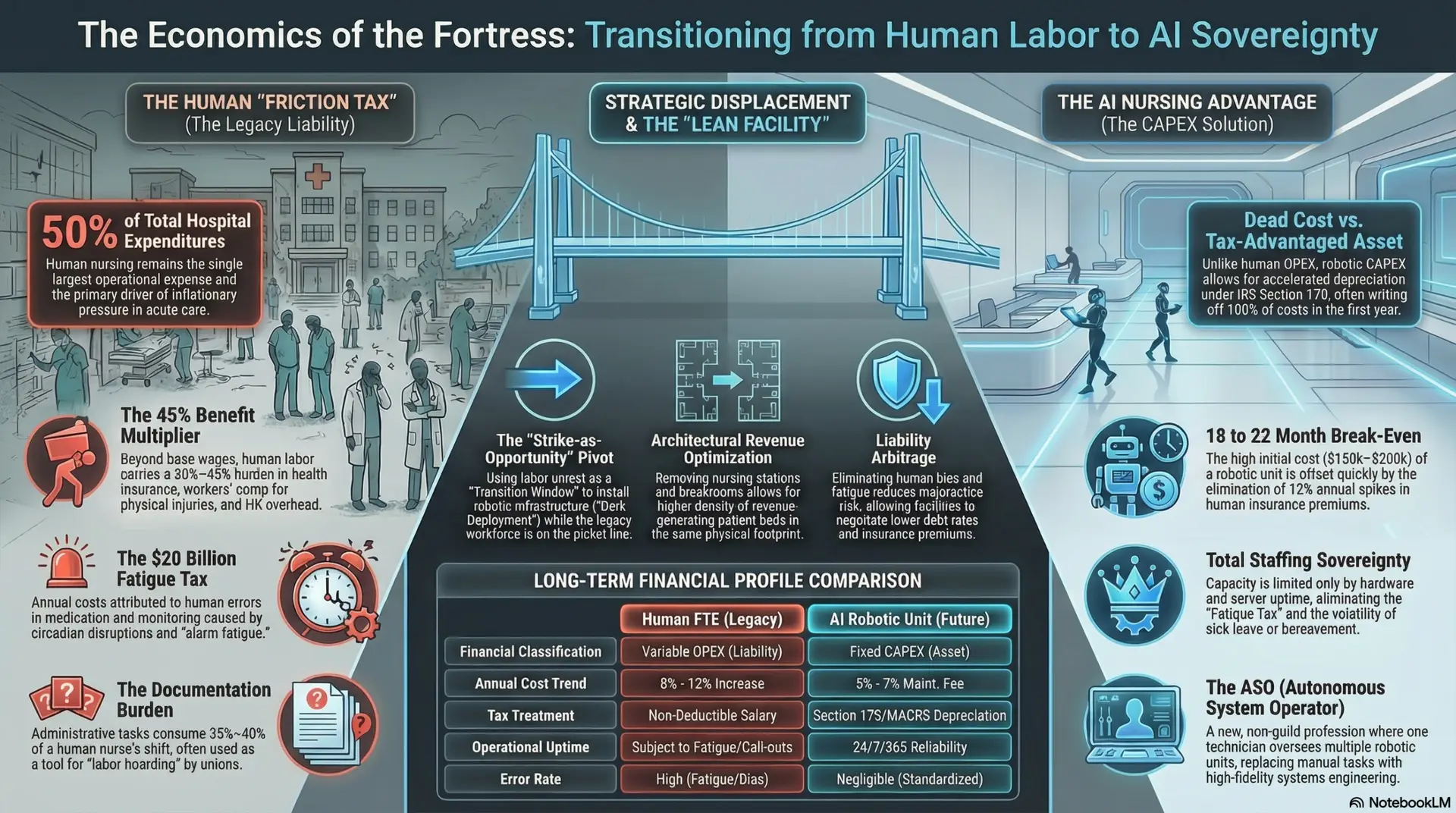
The Economics of the Fortress: Breaking Institutional Friction in Nursing
Author: Jude Chartier RN / AI Nurse Hub Date: March 30, 2026

By: Jude Chartier RN / AI Nurse Hub
Date: February 1, 2026
Abstract
In the high-acuity environment of 2026, the traditional reliance on static manuals, laminated “cheat sheets,” and fragmented intranets for clinical protocols has been rendered obsolete by the integration of Generative AI and Medical Large Language Models (MedLM). This article examines the dual-impact of AI-driven Clinical Decision Support (CDS) on staff nursing and hospital administration. For the staff nurse, AI serves as a “cognitive co-pilot,” providing instantaneous access to evidence-based protocols and real-time diagnostic aids, thereby significantly reducing cognitive load and the paralyzing effects of decision fatigue. For the hospital administrator, these systems ensure a rigorous standardization of care, eliminate costly clinical variability, and provide a technological shield against professional liability. By analyzing current implementations—such as the CMS WISeR model, Wolters Kluwer’s Ovid Synthesis, and ambient documentation loops—this study illustrates how AI-driven protocols are reclaiming thousands of clinical hours and fundamentally shifting patient safety metrics toward zero-harm goals.
Introduction: The End of the “Information Retrieval Lag”
The modern nursing unit in 2026 is no longer hampered by the “information retrieval lag” that characterized the previous two decades of the Electronic Health Record (EHR) era. Historically, nurses spent an estimated 25% to 35% of their shifts searching for specific facility protocols, clarifying complex physician orders, or verifying evidence-based best practices. This “clerical search labor” contributed to cognitive tunneling—a state where a clinician becomes so focused on a single task or piece of missing information that they lose situational awareness of the broader clinical picture.
Today, the convergence of ambient AI and real-time clinical reasoning has fundamentally shifted the nurse’s professional identity. The profession has moved away from being “performers of tasks” toward becoming Strategic Authenticators. In this new paradigm, technology provides the “first pass” of data synthesis and protocol retrieval, while the licensed nurse provides the final clinical verification and ethical oversight (Wolters Kluwer, 2026). This shift is not merely an incremental improvement in efficiency; it is a structural redesign of clinical workflow that prioritizes human intuition where it is most needed while delegating data-heavy processing to the digital guardrail.
Rapid Protocol Access: Solving the “Search-and-Find” Crisis
For the staff nurse, the most immediate and visceral benefit of AI integration is the total elimination of the “search-and-find” burden. In the pre-AI era, a nurse needing to verify the titration parameters for a complex vasocutaneous medication might have to log out of a bedside terminal, find a dedicated workstation, navigate a tiered intranet, and scan a 20-page PDF.
Immediate Bedside Guidance and Voice Integration
Current 2026 systems utilize advanced Natural Language Processing (NLP) to allow nurses to “ask” the environment for specific guidance. Utilizing HIPAA-compliant, voice-activated ambient devices, a nurse can remain at the bedside—maintaining physical contact and eye contact with the patient—while requesting specific protocol parameters. For example, during a sudden hypertensive crisis, a nurse can simply state, “Retrieve the facility’s latest nicardipine titration protocol for acute stroke.”
Systems like the Ovid Synthesis Expert AI perform a real-time critical appraisal of both the hospital’s specific policy and the broader medical literature, translating thousands of pages of documentation into three to five actionable, bulleted prompts delivered via a heads-up display or a secure mobile device in milliseconds (Wolters Kluwer, 2026). This reduces “search time” from an average of seven minutes to less than three seconds. The psychological consequence is a marked reduction in “interruption fatigue,” allowing the nurse to maintain a continuous flow state during high-acuity interventions. As a senior clinical analyst noted, “When we remove the friction of information access, we aren’t just saving time; we are preserving the nurse’s cognitive reserve for the high-level, human-centric advocacy that no machine can replicate” (Stanford Medicine, 2026).
AI-Driven Decision Support: Beyond the Screen
Beyond mere protocol retrieval, AI in 2026 acts as a 24/7 “silent partner” in diagnostics. Unlike traditional EHR alerts that relied on simplistic, single-value thresholds—often leading to “alarm fatigue” and the dangerous desensitization of clinical staff—modern AI models utilize “Deep Reasoning” to monitor longitudinal trends across the entire patient history.
The Sepsis Breakthrough and Predictive Surveillance
A landmark multi-center study from Stanford and Harvard in early 2026 confirmed that AI-integrated nursing workflows have reduced sepsis mortality by a staggering 68% (Stanford Medicine, 2026). The mechanism for this success is predictive surveillance. By monitoring subtle, multi-variate shifts—such as a 5% rise in heart rate combined with a marginal decrease in Mean Arterial Pressure (MAP) and a slight elevation in lactate levels over a six-hour window—the AI “nudges” the nurse to initiate the sepsis bundle hours before a human clinician would typically notice a change in the patient’s physical appearance.
Case Study: Insulin Titration and Fall Prevention
Similar breakthroughs have been seen in metabolic management. AI-driven CDS now manages complex insulin-to-carb ratios and sliding scale titrations by ingesting real-time continuous glucose monitor (CGM) data. The nurse acts as the “authenticator,” reviewing the AI’s proposed dose and signing off, rather than performing manual calculations that are prone to mathematical error under stress. Furthermore, computer-vision-based AI now monitors patient movement patterns, alerting nurses to “pre-fall behaviors”—such as a patient shifting their weight in a specific way that indicates an unassisted exit attempt—allowing for proactive intervention before the fall occurs.
Administrative Outlook: ROI, Standardization, and the Cost of Quality
Hospital administrators view AI-driven protocol access as the primary lever for operational stability and fiscal health in an era of decreasing margins and increasing regulatory scrutiny.
Reducing Clinical Variability and Liability
One of the most significant hidden costs in acute care is clinical variability—instances where different nurses, despite having the same training, follow different versions of a care plan or rely on “experience-based” rather than “evidence-based” heuristics. This variability leads to inconsistent outcomes, increased length of stay (LOS), and a higher rate of readmissions.
The CMS WISeR (Well-Informed Security and Research) model has emerged as the gold standard for administrative oversight. This model now automates the alignment of every care plan with the latest federal and specialty-specific guidelines. For administration, this ensures 100% compliance with evidence-based practice (EBP) metrics. This is not merely a clinical benefit; it is a financial necessity, as CMS reimbursements are increasingly tied to Value-Based Purchasing (VBP) scores and the successful avoidance of “Never Events” (HealthStream, 2026).
Furthermore, AI serves as an institutional liability shield. When a nurse is guided by an AI that is synchronized with the latest legal and clinical standards, the probability of a “sentinel event” due to a protocol error is reduced to near-zero levels. From an actuarial perspective, this has led to a significant decrease in malpractice premiums for hospitals that can prove a “high-fidelity AI-integration” in their nursing workflows. Administrators can realize a significant ROI not only by lowering insurance costs but also by reducing the average LOS through the prevention of avoidable complications.
Staffing Stability, Reliability, and the Knowledge Gap
A persistent challenge for 2026 administrators is the “reliability gap” caused by the global nursing shortage and the resulting reliance on new-graduate nurses or itinerant “traveler” staff. These clinicians often lack the institutional memory of a facility’s unique protocols, creating a “knowledge gap” that increases risk.
AI-driven CDS provides a universal “clinical floor” for all staff, regardless of their years of experience or their tenure at a specific hospital. “The AI doesn’t have a ‘bad day,’ it doesn’t ‘call out,’ and it is never ‘unfamiliar’ with the latest pediatric stroke protocol,” states a 2026 report on hospital throughput (SullivanCotter, 2026). Because the AI is always present and updated in real-time—often reflecting policy changes within minutes of their approval by the Board of Nursing—it stabilizes the unit’s performance. This technological reliability creates a more predictable clinical environment, which data shows significantly reduces the stress on permanent nursing staff, lowering the burnout-driven churn rate that costs hospitals hundreds of thousands of dollars in recruitment and onboarding annually.
The Strategic Authenticator Role: The Human-in-the-Loop Requirement
To maximize these benefits, the professional identity of the nurse has undergone a metamorphosis into the role of Strategic Authenticator. This model preserves the ethical and legal mandate that a licensed professional remains the final authority on patient care, while leveraging the “super-human” processing power of AI.
This “human-in-the-loop” requirement ensures that technology handles the data drudgery, but the human element remains the final authority. It transforms the nurse from a “task-doer” into a “clinical commander,” ensuring that the nursing license—and the patient’s safety—are protected by both digital precision and human wisdom.
Conclusion: The Future of “Augmented Caring”
AI-augmented protocol access and decision support represent the most significant advance in nursing efficiency and professional status of the 21st century. By reclaiming the thousands of hours once lost to administrative searching and providing a predictive safety net for complex diagnoses, technology has empowered nurses to return to the bedside as strategic leaders rather than clerical laborers.
For hospital leadership, the investment in these systems provides a clear and measurable path to fiscal stability, standardized care, and a more resilient, satisfied clinical workforce. As we move further into 2026, the hospitals that thrive will be those that view AI not as a replacement for the nurse, but as the essential digital guardrail that allows the nurse to practice at the absolute top of their license.
References
HealthStream. (2026). CNO nursing trends 2026: The rise of the augmented workforce and the cost of clinical variability. https://www.healthstream.com/cno-trends-to-watch-2026
Stanford Medicine. (2026, January 31). Clinical AI has boomed: Mortality rates plummet with nurse-led AI integration and predictive sepsis alerts. https://medicine.stanford.edu/news/current-news/standard-news/clinical-ai-has-boomed.html
SullivanCotter. (2026, January 6). How AI will shape the future of health care in 2026: ROI and the stabilization of the clinical workforce. https://sullivancotter.com/ai-and-the-future-of-health-care/
Wolters Kluwer Health. (2026, January). Ovid Synthesis Expert AI: Accelerating the implementation of evidence-based practice and protocol retrieval at the bedside.
Author: Jude Chartier RN / AI Nurse Hub Date: March 30, 2026
By: Jude Chartier RN / AI Nurse Hub Date: March 23, 2026
By: Jude Chartier RN / AI Nurse Hub Date: March 19, 2026