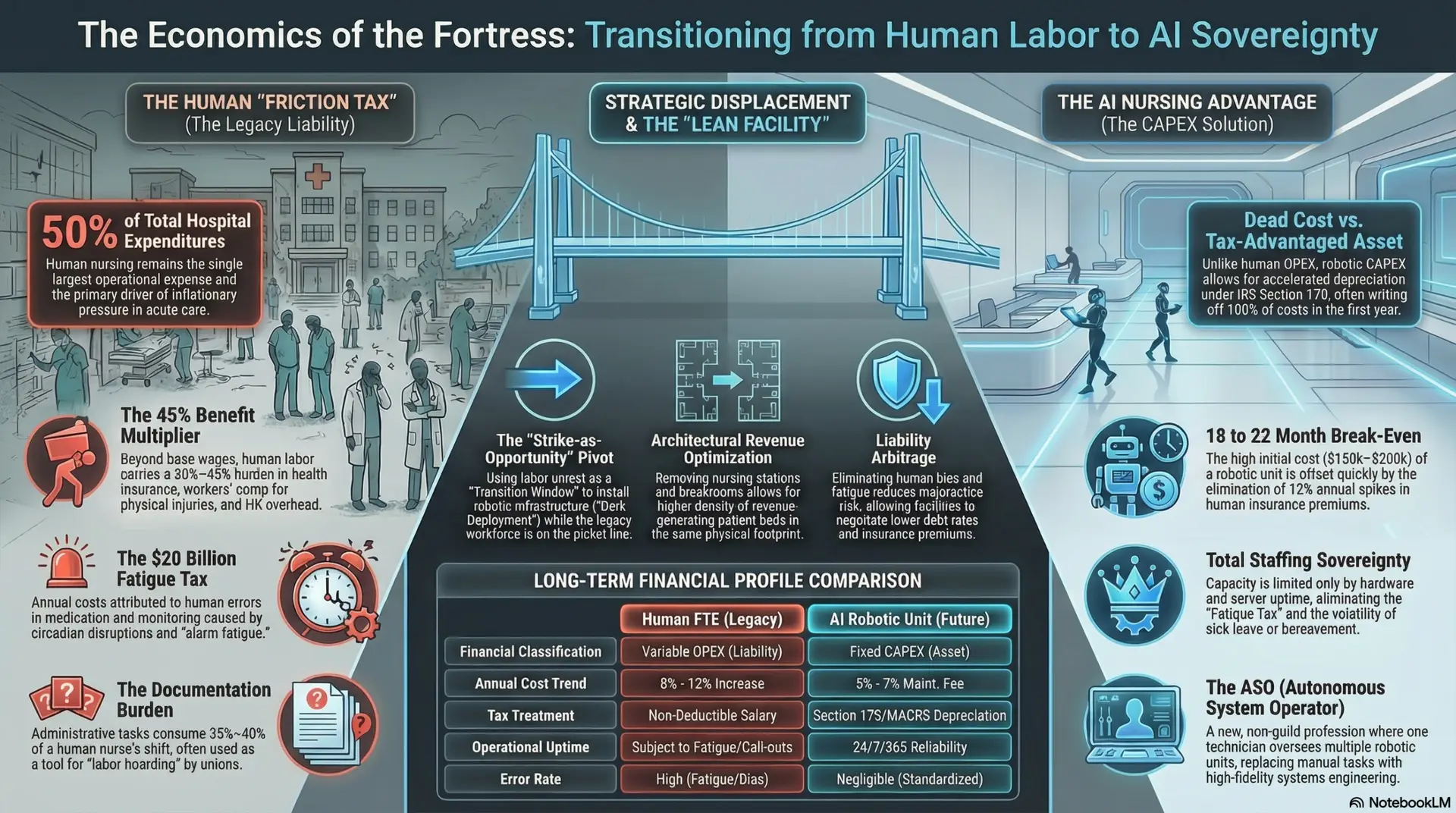
The Economics of the Fortress: Breaking Institutional Friction in Nursing
Author: Jude Chartier RN / AI Nurse Hub Date: March 30, 2026

By: [Jude Chartier RN / AI Nurse Hub]
Date: January 18, 2026
Abstract
As artificial intelligence (AI) transitions from theoretical potential to bedside application, hospitals and health systems face a “readiness paradox.” While technological capabilities have advanced rapidly, the integration of AI into the nursing workflow remains a significant hurdle. This article examines the current state of AI readiness within health systems, focusing on the shifting role of the nurse. It explores the dualities of AI adoption: the promise of reduced documentation burdens and enhanced patient monitoring versus the fears of job displacement, the erosion of nursing intuition, and increased cognitive load. By synthesizing current reports and nursing-specific informatics research, the analysis concludes that true readiness requires a “nurse-first” approach to implementation that prioritizes professional autonomy, clinical judgment, and ethical advocacy alongside technical deployment.
Introduction: The Nursing Readiness Paradox
The healthcare industry is currently caught in an AI “gold rush,” spurred by the rapid emergence of generative AI and predictive analytics. However, a significant gap exists between the high-level enthusiasm of executive leadership and the practical, bedside reality for the nursing workforce. A 2024 report by Kyndryl, featured in Healthcare IT News, revealed that while leaders are bullish on AI’s benefits, nearly 49% of organizations have seen innovation delayed due to a lack of technical readiness and workforce integration (Sanders, 2024).
For nurses—the primary users of health information systems and the central coordinators of patient care—this “readiness paradox” is particularly acute. Having the technology available in a facility is not synonymous with having a tool that is functionally ready for the high-stakes, fast-paced environment of a medical-surgical floor or an intensive care unit. True readiness depends on a health system’s ability to seamlessly integrate AI into the nursing process (Assessment, Diagnosis, Planning, Implementation, and Evaluation) without compromising the human-to-human connection that defines the profession. Without a deliberate strategy that accounts for the fluid nature of the nursing workflow, AI risks becoming another digital barrier between the nurse and the patient, rather than a bridge to better care.
The Pillars of System Readiness for Nursing
Before nursing staff can be expected to embrace AI, the underlying system must be structurally sound and designed with nursing-specific workflows in mind. This involves moving beyond “technical readiness” toward “operational readiness.”
Data Integrity and Nursing Documentation
Predictive AI adoption in hospitals reached 71% in 2024 (HealthIT.gov, 2024). However, many AI models rely heavily on data pulled from nursing documentation. If the data is siloed, inconsistent, or entered under the duress of a staffing crisis, the AI may produce inaccurate risk scores. For instance, if a nurse is forced to “batch chart” at the end of a shift, an AI model that requires real-time vitals to predict sepsis may fail to trigger an alert until the window for intervention has closed. Nursing-led governance is essential to ensure that AI tools are trained on accurate “real-world” nursing data rather than idealized datasets. Without this, AI-driven recommendations may inadvertently exacerbate health disparities or provide irrelevant clinical prompts that do not reflect the nuances of holistic patient care.
The Pilot-to-Scale Gap in Nursing Units
Many systems succeed in small AI pilots, but struggle to scale these tools across diverse nursing specialties. A tool designed for an ICU nurse, focusing on high-frequency physiological data like arterial line readings, might fail for a home health or community nurse who relies on longitudinal observations and social determinants of health. This “digital divide” means that rural or under-funded units may be forced to manage the risks of implementation without the necessary support, leading to increased stress and burnout for the nursing staff (Health Affairs, 2024). The consequence of a failed rollout is often “technological distrust,” where a single poor experience with a scaled tool colors a nurse’s perspective on all future innovations.
The Evolving Role: From Task-Oriented to Strategic Oversight
The introduction of AI fundamentally alters the professional identity and daily cadence of the nurse. The role is shifting from a “data collector” to a “strategic validator” and “human advocate.”
Human-in-the-Loop and Nursing Judgment
The American Nurses Association (ANA, 2024) emphasizes that AI should augment, not replace, nursing judgment. The “Human-in-the-Loop” (HITL) model requires nurses to remain the final arbiters of care. For example, while an AI might flag a patient for potential sepsis based on lab values, the nurse must validate that data against their own physical assessment—noting skin temperature, mental status, or a “gut feeling” that the patient is deteriorating. This transition requires a new set of competencies; medical and nursing education must evolve to include “AI literacy,” enabling nurses to identify “algorithmic bias” or “hallucinations” in predictive models. The nurse of the future is not just a caregiver but a supervisor of intelligent systems, tasked with identifying when the “math” of the AI conflicts with the “reality” of the patient.
Advantages: The Case for Nursing-AI Synergy
For the bedside nurse, the primary advantage of AI is its potential to mitigate the burnout crisis by stripping away “administrative friction” and restoring the ability to focus on direct patient care.
Reducing the “Documentation Tax
Nursing documentation is a primary driver of burnout, often requiring nurses to stay after their shifts to finish charts, a phenomenon known as “working off the clock.” Ambient AI tools that summarize patient assessments or automate the transcription of handover reports can save nurses significant time during shift changes. By automating the clerical aspects of the electronic health record (EHR)—such as drafting nursing notes or categorizing intake and output—AI allows nurses to return to “top-of-license” work, spending more time at the bedside and less time staring at a workstation (AMA, 2025).
Predictive Safety Nets and Staffing
AI serves as a tireless “second set of eyes” that never experiences fatigue. Predictive models can monitor patient trajectories across an entire unit, catching early signs of deterioration—such as subtle changes in heart rate variability or oxygen saturation—that a nurse managing a heavy patient load might miss in a momentary distraction. Furthermore, AI-driven predictive staffing can help nurse managers forecast patient acuity levels rather than just “census numbers.” This allows for more equitable assignments based on the actual intensity of care required, ensuring safer nurse-to-patient ratios and a reduction in the moral injury that occurs when nurses feel they are too understaffed to provide safe, dignified care (American Nurse Journal, 2024).
The Psychology of Reluctance: Concerns from the Frontline
Despite these advantages, many nurses remain reluctant to adopt AI. This resistance is often rooted in concerns about the “dehumanization” of care and the potential loss of professional autonomy.
Job Security and the Value of Empathy
There is a persistent anxiety that AI will be used by administrators to justify higher patient ratios or to automate tasks that require human judgment. Nurses worry that the unique, empathetic value of the “human touch”—the ability to comfort a grieving family or advocate for a patient’s wishes during a crisis—will be devalued in a push for mechanized productivity. While AI can process vast amounts of data, it cannot provide the emotional support, spiritual care, or ethical advocacy that defines the nursing profession (PMC, 2025). The reluctance stems from a fear that “efficient care” will eventually replace “compassionate care.”
The Erosion of Nursing Intuition
Experienced nurses often rely on “clinical intuition”—a sense that a patient is “about to turn” before the monitors show it. There is a fear that newer nurses may become overly dependent on AI prompts, failing to develop this critical skill. This “skill degradation” could lead to a loss of the art of nursing to the science of the algorithm, making the workforce less resilient during technology failures or in “edge-case” scenarios where AI lacks sufficient training data. If a nurse stops questioning the AI, they stop practicing nursing and start practicing data entry.
Liability and Alert Fatigue
The legal landscape for nursing remains a major concern and a primary source of reluctance. If a nurse follows an AI recommendation that results in a medical error, the nurse is often still held professionally and legally liable, as the “human-in-the-loop” is expected to catch machine failures. Furthermore, “Alert Fatigue 2.0” is a significant risk. If an AI system generates too many false-positive alarms or irrelevant prompts, nurses may suffer from cognitive overload, leading them to instinctively ignore notifications. This desensitization can result in missing a critical signal buried in a sea of digital noise, creating a new and dangerous type of medical error.
Bridging the Gap: Moving Toward Partnership
To move from reluctance to partnership, health systems must adopt a “Nursing-Centric” implementation strategy that respects the unique role of the nurse:
Conclusion
Health systems are technically ready for AI, but they are only “nursing-ready” when the technology supports the nurse rather than adds to their burden. True readiness is not measured by the number of algorithms deployed, but by the degree to which AI empowers nurses to provide safer, more compassionate, and more efficient care. By focusing on burnout mitigation and professional partnership, health systems can ensure that the future of healthcare is one where AI handles the data, allowing the nurse to handle the patient.
References
American Medical Association. (2025). AI scribes save 15,000 hours—and restore the human side of medicine. https://www.ama-assn.org/practice-management/digital-health/ai-scribes-save-15000-hours-and-restore-human-side-medicine
American Nurses Association. (2024). Position Statement: Artificial Intelligence in Nursing Practice. https://www.nursingworld.org/practice-policy/nursing-excellence/official-position-statements/
American Nurse Journal. (2024). How AI is revolutionizing nurse staffing and patient acuity. https://www.google.com/search?q=https://www.myamericannurse.com/ai-nurse-staffing/
Health Affairs. (2024). Artificial Intelligence In Health And Health Care: Priorities For Action. https://www.healthaffairs.org/doi/10.1377/hlthaff.2024.01003
HealthIT.gov. (2024). Hospital Trends in the Use, Evaluation, and Governance of Predictive AI, 2023-2024. Office of the National Coordinator for Health Information Technology.
Sanders, J. (2024, October 27). Are hospitals and health systems really ready for AI? Healthcare IT News. https://www.healthcareitnews.com/news/are-hospitals-and-health-systems-really-ready-ai
World Health Organization. (2024). Ethics and governance of artificial intelligence for health: Guidance on large multi-modal models. https://www.who.int/publications/i/item/9789240084759
Author: Jude Chartier RN / AI Nurse Hub Date: March 30, 2026
By: Jude Chartier RN / AI Nurse Hub Date: March 23, 2026
By: Jude Chartier RN / AI Nurse Hub Date: March 19, 2026