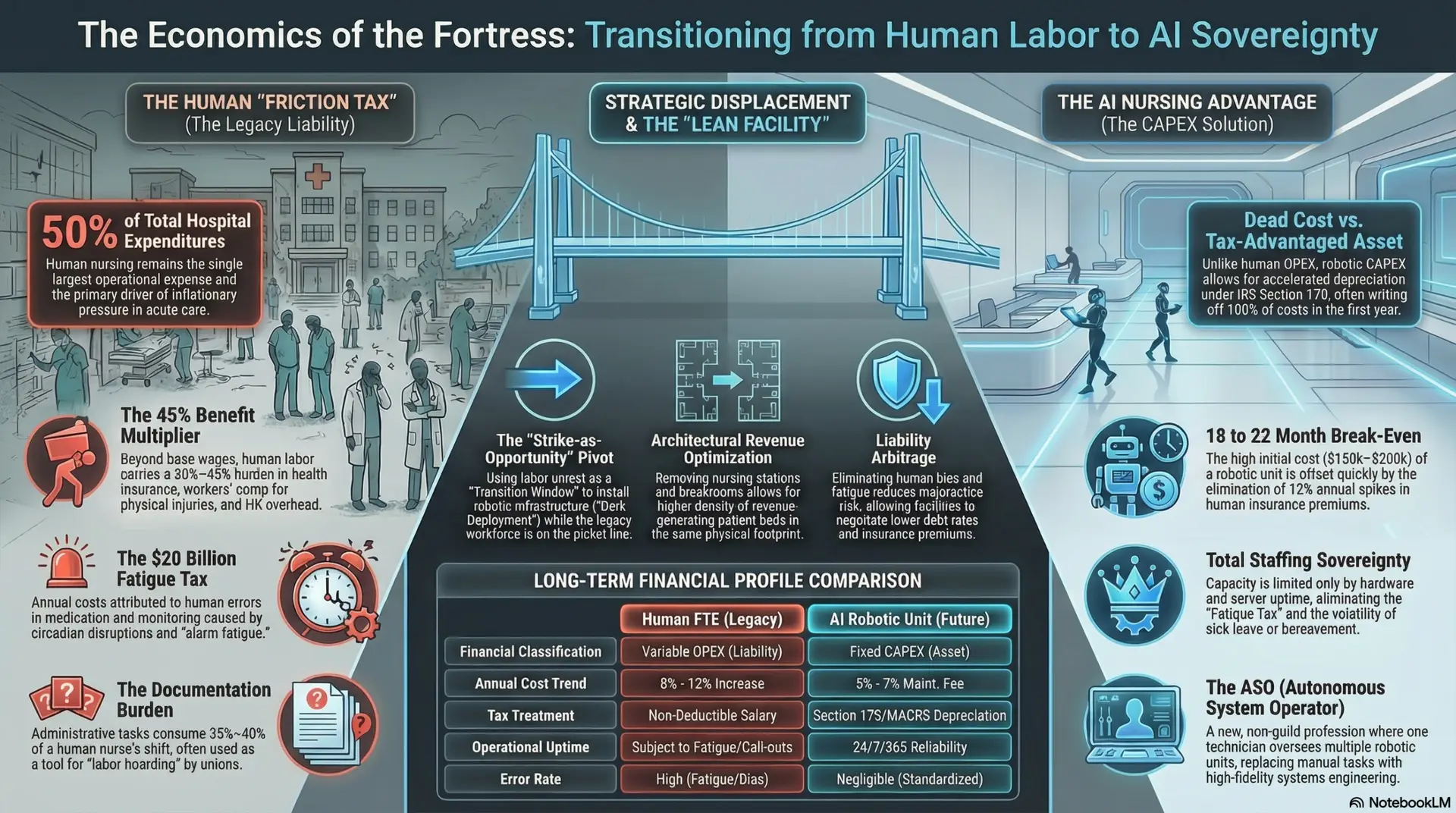
The Economics of the Fortress: Breaking Institutional Friction in Nursing
Author: Jude Chartier RN / AI Nurse Hub Date: March 30, 2026
A Strategic Analysis and ROI Guide for Healthcare Leaders
By: Jude Chartier RN /AI Nurse Hub
Date: February 9, 2026
The “Quiet” Crisis at the Nurse’s Station
Imagine a 40-bed medical-surgical unit at 10:00 AM. The environment is defined by a relentless cacophony: the rhythmic chirping of telemetry monitors, the sharp ring of the unit clerk’s phone, and the persistent chime of patient call bells. For the modern nurse, this is more than just noise; it is a state of constant cognitive fragmentation. This “sensory assault” creates a workplace where critical thinking is perpetually interrupted by low-acuity logistical demands.
The healthcare industry is currently grappling with a “quiet” crisis that threatens both clinician well-being and patient safety. The Joint Commission (2013) identified “alarm fatigue” as a major patient safety risk, yet a decade later, the burden has merely shifted from bedside monitors to wearable communication devices. This constant interruption creates a significant Task Switching Cost. Every time a nurse is forced to pivot from a complex clinical task—such as calculating a high-risk medication drip—to answer a phone call about a patient’s lunch tray, their “mental RAM” is cleared.
Research suggests that clinical interruptions are significantly associated with an increase in procedural failures and clinical errors (Westbrook et al., 2010). Furthermore, “Interruption Science” reveals that it can take an average of 23 minutes and 15 seconds to return to the original task after an interruption (Mark et al., 2008). In a 12-hour shift, these “minutes of recovery” aggregate into hours of lost clinical productivity, compromising the nurse’s ability to work at the top of their license and resulting in what clinicians often call “death by a thousand cuts.”
Why the Current System is Breaking: The Nuisance Burden
The primary driver of station congestion is the “nuisance call.” Industry benchmarks indicate that approximately 60% to 70% of patient call-bell requests are for non-clinical needs—requests for water, fresh linens, assistance with the television, or inquiries about the weather (HIMSS, 2022). In a traditional system, these calls are treated with the same urgency as a clinical deterioration alert, ringing at a central hub or on a nurse’s primary device.
When these calls are routed indiscriminately, the results are devastating to unit operations:
Five AI Pillars to Silence the Noise: The Market Landscape
To address this, forward-thinking organizations are moving away from “dumb” communication hubs and toward AI-driven architectures that act as a sophisticated filter. Below is the current market landscape of solutions designed to filter, delegate, and automate these interactions.
1. Voice AI for Public and Family Inquiries
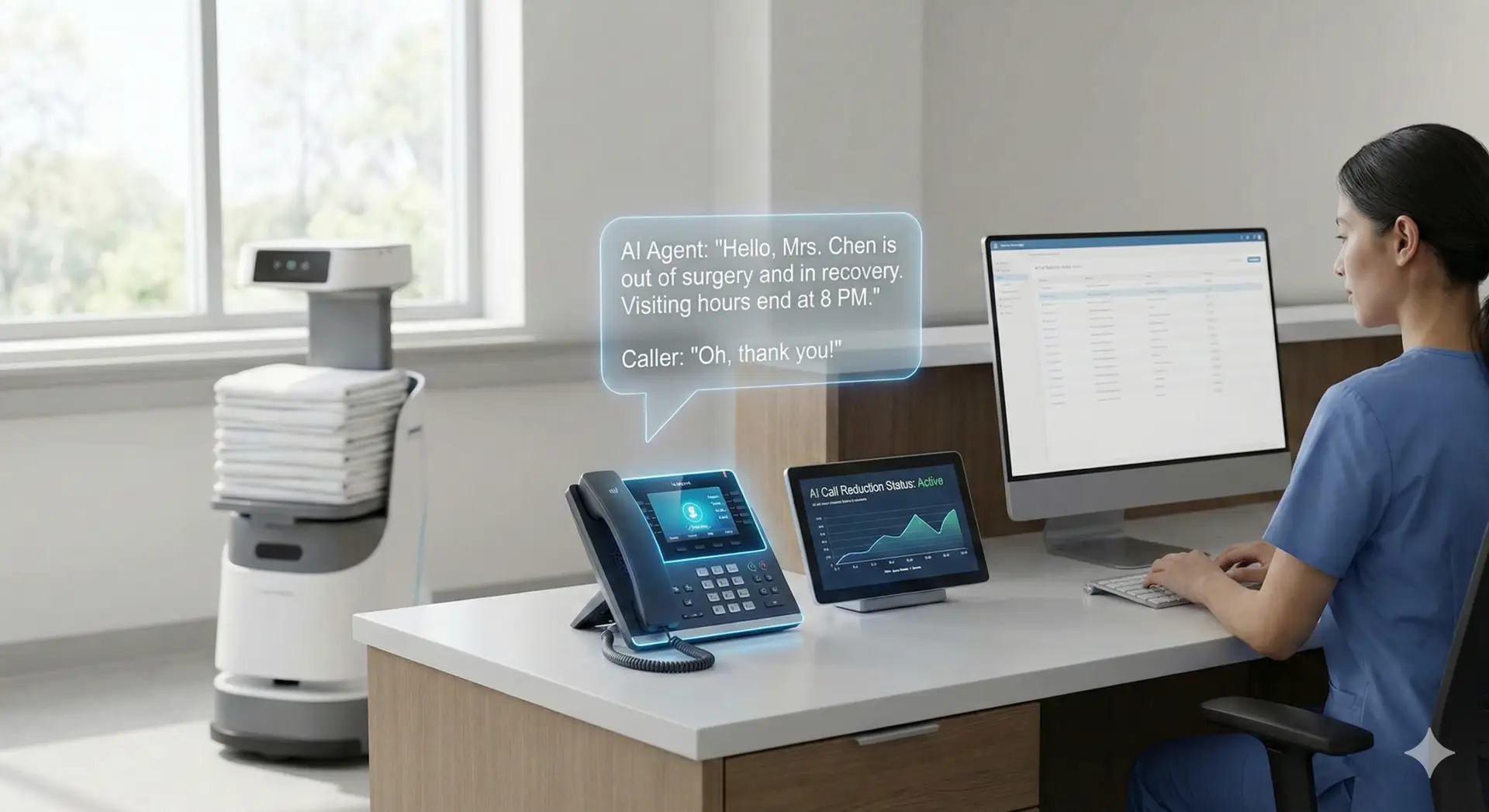
Natural Language Processing (NLP) agents can now handle the massive volume of inbound calls regarding visiting hours, parking, or general status updates. These systems use advanced speech-to-text and sentiment analysis to provide answers instantly, 24/7.
2. Intelligent Triage & Smart Call Bells
AI request classification ensures that the right request goes to the right person. If a patient says “I need water,” the AI routes the request to a CNA or a delivery robot. If they say “I have chest pain,” it triggers an immediate, high-priority alert to the RN.
3. Virtual Nursing: Offloading the Administrative Burden
The “Virtual Nurse” is an experienced clinician working from a remote hub who handles the “phone-heavy” portions of a hospital stay. This hybrid model allows the bedside nurse to stay in the room while the virtual nurse manages the logistics.
4. Ambient Clinical Documentation
One of the most frequent reasons for station calls is a physician or lab tech asking for a “status update” because the chart hasn’t been updated yet. Ambient AI listens to the nurse-patient interaction and drafts the note in real-time.
5. Predictive Staffing & Automated Coverage
Much of the chaos at a nurse’s station is internal—the frantic calling of other units or agencies to fill a shift after a last-minute call-out. AI can predict these surges and automate the recovery.
Visualizing the Impact: The Nursing ROI Dashboard
To help leadership teams quantify the value of these technologies, we have developed an interactive AI Communication ROI Dashboard. This tool allows you to model a 40-bed unit to see how much nursing labor can be reclaimed by filtering out the “noise” and automating staffing.
Access the Interactive Dashboard Here
📖 User Guide: How to Use the ROI Tool
The Cultural Transformation: Implementation Strategy
Successfully reducing call volume requires more than just installing software; it requires a shift in the “nursing culture.” Leadership must address several key areas:
From “Time Saved” to “Time Reinvested”
The ultimate goal of AI in nursing is not to replace the human element, but to protect it. When a 40-bed unit reclaims 100+ hours a month, the dividends are paid in three critical areas:
Conclusion: The Future is Quiet
The hospital of the future should not sound like a call center; it should sound like a place of healing. Technology has historically been a source of distraction for nurses, but AI offers the first real opportunity to reverse that trend. By implementing AI pillars that triage, document, and predict, healthcare leaders can finally silence the noise and return the focus to where it belongs: the patient.
References
Author: Jude Chartier RN / AI Nurse Hub Date: March 30, 2026
By: Jude Chartier RN / AI Nurse Hub Date: March 23, 2026
By: Jude Chartier RN / AI Nurse Hub Date: March 19, 2026