By: Jude Chartier RN / AI Nurse Hub
Date: February 19, 2026
Abstract
The global nursing workforce is navigating a period of unprecedented strain, characterized by systemic shortages, escalating burnout, and an aging clinical demographic. Medical-surgical (med-surg) units, often considered the “engine room” of the hospital, experience the highest levels of staff turnover, moral injury, and administrative friction. Longitudinal time-and-motion studies indicate that a significant portion of a nurse’s 12-hour shift is consumed by non-clinical administrative tasks, fragmented communication, and logistical “hunting and gathering.” This article provides an extensive review of four distinct, commercially available technological categories: ambient artificial intelligence (AI) documentation, hands-free wearable communication, automated medication inventory systems, and autonomous delivery robots. By synthesizing data from recent clinical trials and hospital case studies, this review demonstrates that the strategic implementation of these tools can reclaim approximately 120 minutes of clinical time per shift. Furthermore, this article explores the economic imperative of these technologies, arguing that while initial deployment costs are significant, the return on investment (ROI) follows an exponential trajectory. This “Two-Hour Gift” is presented not merely as an efficiency metric, but as a fundamental restructuring of the nursing workflow to preserve the workforce and enhance patient safety.
Introduction: The Anatomy of Time Poverty
The modern medical-surgical environment is a high-stakes ecosystem characterized by rising patient acuity and a disproportionate administrative load. As the American Association of Colleges of Nursing (AACN, 2023) notes, the United States is projected to face a shortage of nearly 80,000 registered nurses by 2025. While recruitment and academic pipelines remain essential, a parallel and perhaps more immediate strategy involves “reclaiming” time from the existing workforce through aggressive workflow optimization and the elimination of “slop” in clinical operations.
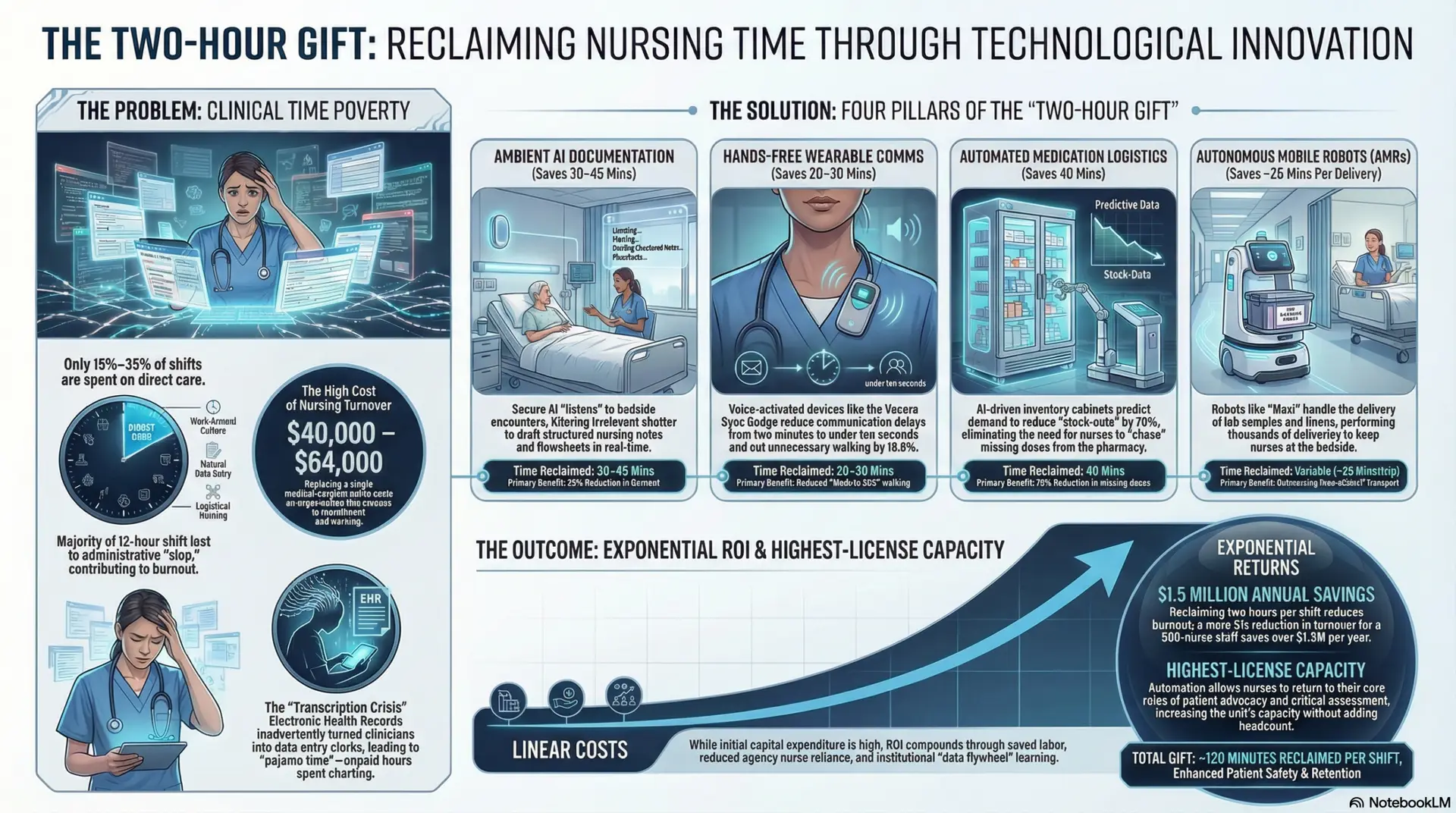
Current literature consistently reveals a startling “time poverty” in nursing: clinicians often spend as little as 19.3% to 35% of their time on direct patient care (JAMA Network Open, 2025). The remainder of the 12-hour shift is lost to “work-around culture”—a series of manual, repetitive tasks that do not require a nursing license but are currently performed by licensed staff due to infrastructure gaps. This includes searching for missing medications, walking to supply rooms for linen, and redundant data entry. This article identifies four “ready-for-deployment” technologies that bridge these gaps. By automating documentation, streamlining communication, predicting supply needs, and outsourcing physical transport, hospitals can return two hours of clinical focus to every nurse, every shift, effectively increasing the “highest-license” capacity of the unit without adding additional headcount.
Ambient AI Documentation: The Transcription Crisis
Documentation remains the most significant driver of “moral distress” and professional dissatisfaction. The transition to Electronic Health Records (EHRs) was intended to improve data accessibility but has inadvertently shifted the nurse’s primary role from a clinician to a data entry clerk. This shift is most visible in “pajama time,” the unpaid hours spent charting after a shift concludes to ensure compliance and legal defensibility.
The Evidence and Technical Mechanics
A 2024 pragmatic randomized trial published in NEJM AI and JAMA Network Open evaluated the efficacy of ambient AI scribes. These systems utilize advanced Natural Language Processing (NLP) and Large Language Models (LLMs) to passively “listen” to bedside clinical encounters through secure, encrypted devices. Unlike traditional voice-to-text, ambient AI distinguishes between multiple voices, filters out irrelevant “chatter” (such as family conversations about the weather), and extracts pertinent clinical data to draft structured SOAP notes or nursing flowsheets. The study demonstrated that these systems reduced documentation time by an average of 30 to 45 minutes per day, with a concurrent 25% reduction in self-reported clinician burnout (UW Health, 2024).
Operational Impact and Cognitive Load
By deploying ambient clinical intelligence (ACI), med-surg units can transition from retrospective to real-time documentation. This reduces the “cognitive load”—the mental effort required to hold complex information in short-term memory (e.g., wound measurements or specific patient responses to pain medication) until it can be typed. Kaiser Permanente’s evaluation of over 7,000 clinicians resulted in 16,000 hours saved in 15 months, demonstrating that at scale, ACI acts as a massive force multiplier for clinical capacity. Furthermore, the accuracy of the record improves, as data is captured at the point of care rather than through memory-based entry hours later (American Medical Association, 2024).
Hands-Free Comms: Mitigating Interruption Science
In a typical 12-hour shift, a med-surg nurse can walk between four and seven miles. A significant portion of this distance is driven by fragmented communication—physically walking to a central desk to check a phone, searching for a CNA to help with a patient boost, or standing outside a room waiting for a provider to emerge.
The Evidence of “Work-to-Talk”
Research published in CIN: Computers, Informatics, Nursing investigated the role of hands-free wireless communication devices (HWCDs) in acute care. The findings were stark: the implementation of voice-activated wearables reduced communication delays from a median of two minutes to under ten seconds. More importantly, the technology was associated with a 19.8% reduction in “unnecessary walking,” as nurses could coordinate care from within the patient’s room rather than transiting to the nurse station (Cooney et al., 2025).
Implementation and Clinical Outcomes
Unlike traditional smartphones, which require the nurse to remove gloves and break the sterile field to answer a call, devices like the Vocera Sync Badge allow for voice-to-text and direct-dialing via simple voice commands. This creates a “closed-loop” communication environment. When a nurse can instantly broadcast a request for assistance—stating, “I need a second person for a turn in room 405″—without leaving the bedside, patient safety is enhanced. This is particularly vital in preventing falls and addressing rapid clinical deteriorations where every second of nurse presence is critical. By reducing the “noise” of overhead paging and the friction of the “walk-to-talk” culture, nurses reclaim 20 to 30 minutes of time previously lost to logistical transit.
Automated Medication Logistics and Inventory
Inefficiencies in the medication supply chain—such as “missing doses,” line-ups at the Automated Dispensing Cabinet (ADC), and pharmacy delivery delays—fragment the nurse’s focus and increase the risk of errors. The “medication pass” is the most cognitively taxing part of the shift, and any interruption can be catastrophic.
The Evidence of Predictive Stocking
Research from the Journal of Patient Safety highlights that up to 30% of medication-related delays are due to inventory “stock-outs.” Recent advances in AI-driven inventory management allow ADCs to interface directly with the EHR and real-time census data to predict precisely which medications will be needed on a specific floor in the next 24 hours. Studies have shown that predictive restocking can reduce missing doses by up to 70%, effectively eliminating the need for nurses to call the pharmacy to “chase” medications (Tandfonline, 2023).
Operational Implications and Safety
Modern ADCs (such as the Omnicell Titan XT) use deep learning to forecast demand, reducing waiting time. When the correct medication is reliably present and the administration process is digitally guided (via barcode medication administration or BCMA integration), the nurse reclaims 10 to 20 minutes per medication pass. Across a standard shift with three to four passes, this translates to nearly 40 minutes. This also reduces the “Swiss Cheese Model” of accidents, where small logistical failures (like a missing dose) create the conditions for a larger clinical error (like a distracted nurse administering the wrong drug).
Autonomous Mobile Robots (AMRs
Nurses are frequently utilized as the hospital’s “default” delivery service. This “hunting and gathering” for lab samples, linens, or specialized equipment is a symptom of poor logistical infrastructure. Every trip to the lab is a 15-minute period where a nurse is unavailable for patient emergencies.
The Evidence of Robotic Assistance
Mary Washington Healthcare (2023) integrated the Moxi autonomous robot into med-surg workflows. Over 14 months, two robots performed over 27,500 deliveries, saving clinical staff over 14,300 hours of transit time. On average, a single robot delivery saved a nurse 26 minutes of round-trip travel (Diligent Robotics, 2023). The robots were utilized for everything from fetching specialized pillows for patient comfort to delivering STAT lab samples.
Operational Impact and Safety
AMRs utilize LiDAR and computer vision to navigate complex corridors, operate elevators, and bypass obstacles without human intervention. By outsourcing “non-clinical” logistical tasks to a robot, the hospital ensures that its highly trained assets—registered nurses—remain on the unit. This reduces physical fatigue, a major contributor to work-related injuries and long-term attrition. The robots do not replace the nurse; they act as a “mechanical CNA,” handling the heavy lifting and the long-distance travel that currently depletes human clinical resources.
Exponential ROI and the Cost of Inaction
The primary barrier to implementing these technologies is the initial capital expenditure (CapEx). However, a purely linear cost-benefit analysis fails to capture the long-term fiscal benefits and the compounding returns of technological deployment.
The Curve of Exponential Return
Initial implementation is characterized by high upfront costs (hardware procurement, EHR integration, and staff training). However, the ROI does not remain static; it follows an exponential trajectory driven by three primary factors:
- Retention and Turnover Savings: The cost of replacing a single med-surg nurse is estimated between $40,000 and $64,000. Reclaiming two hours per shift correlates with reduced burnout and higher retention. A 5% reduction in turnover on a 500-nurse staff can save an organization over $1.5 million annually.
- The “Data Flywheel” Effect: Early deployment allows AI systems to learn from unit-specific workflows. As these systems move from “learning” to “predictive” phases, their efficiency gains compound. An ambient AI system becomes more accurate at drafting unit-specific nursing notes over time, further reducing verification labor.
- The Cost of Inaction: Organizations that fail to automate will face escalating labor costs and reliance on expensive travel nursing agencies. The “Two-Hour Gift” effectively increases the unit’s capacity without increasing its payroll, providing a sustainable path through the nursing shortage.
From Deployment to Innovation
Deploying these tools today creates a platform for future innovations. Units that adopt AMRs today will be the first to integrate automated waste management or pharmacy-to-robot direct dispensing tomorrow. The ROI increases as the institution shifts from “buying tools” to “cultivating a tech-enabled ecosystem.”
The Human-Centered: Beyond Automation
For these tools to be successful, they must be implemented with a focus on “Human-Centered Design.” Technological deployment is as much a culture change as it is a software update.
Change Management and Trust
The “Two-Hour Gift” is only realized if nurses trust the technology. This requires transparent communication about the role of AI and robotics—emphasizing that these tools are designed to augment, not replace, human judgment. Successful deployments involve “Nurse Champions” who help design the voice commands for AI or the delivery routes for robots. When nurses see the robot as a partner that saves them a trip to the basement, “buy-in” becomes organic.
Conclusion: A New Era of Nursing Presence
The cumulative impact of these four technologies—ambient AI, hands-free wearables, intelligent ADCs, and autonomous robots—is the recovery of approximately 120 minutes of nursing time per shift. Reclaiming this time is a psychological, clinical, and economic intervention. It allows nurses to return to the core tenets of their profession: patient advocacy and critical assessment.
For hospital administrators, the “Two-Hour Gift” represents a pivot from a reactive “hiring” strategy to a proactive “retention” strategy. While the initial investment is substantive, the exponential ROI—driven by saved labor, reduced turnover, and the acceleration of institutional learning—makes these technologies the baseline requirement for a sustainable and safe modern healthcare system. The tools are available now; the only remaining variable is the organizational will to deploy them.
References
American Association of Colleges of Nursing (2023). Nursing Shortage Fact Sheet.
American Medical Association (2024). AI scribes save 15,000 hours—and restore the human side of medicine.
Cooney, H. J., et al. (2025). Impact of a Hands-free Wireless Communication Device on Communication and Clinical Outcomes. Pediatric Quality and Safety / CIN: Computers, Informatics, Nursing.
Diligent Robotics & Mary Washington Healthcare (2023). Integrating Automation: Moxi’s Impact on Nursing Workflow.
JAMA Network Open (2025). Ambient Artificial Intelligence Scribes: Utilization and Impact on Documentation Time.
NEJM AI (2024). Studies find AI technology for clinical documentation aids efficiency and reduces burnout.
Tandfonline (2023). Artificial intelligence (AI) in pharmacy: An overview of innovations.
UW Health (2024). The impact of Ambient Clinical Intelligence on Nursing Satisfaction and Retention: A Multi-Site Trial.