By: Jude Chartier RN / AI Nurse Hub
Date: February 11, 2026
Abstract
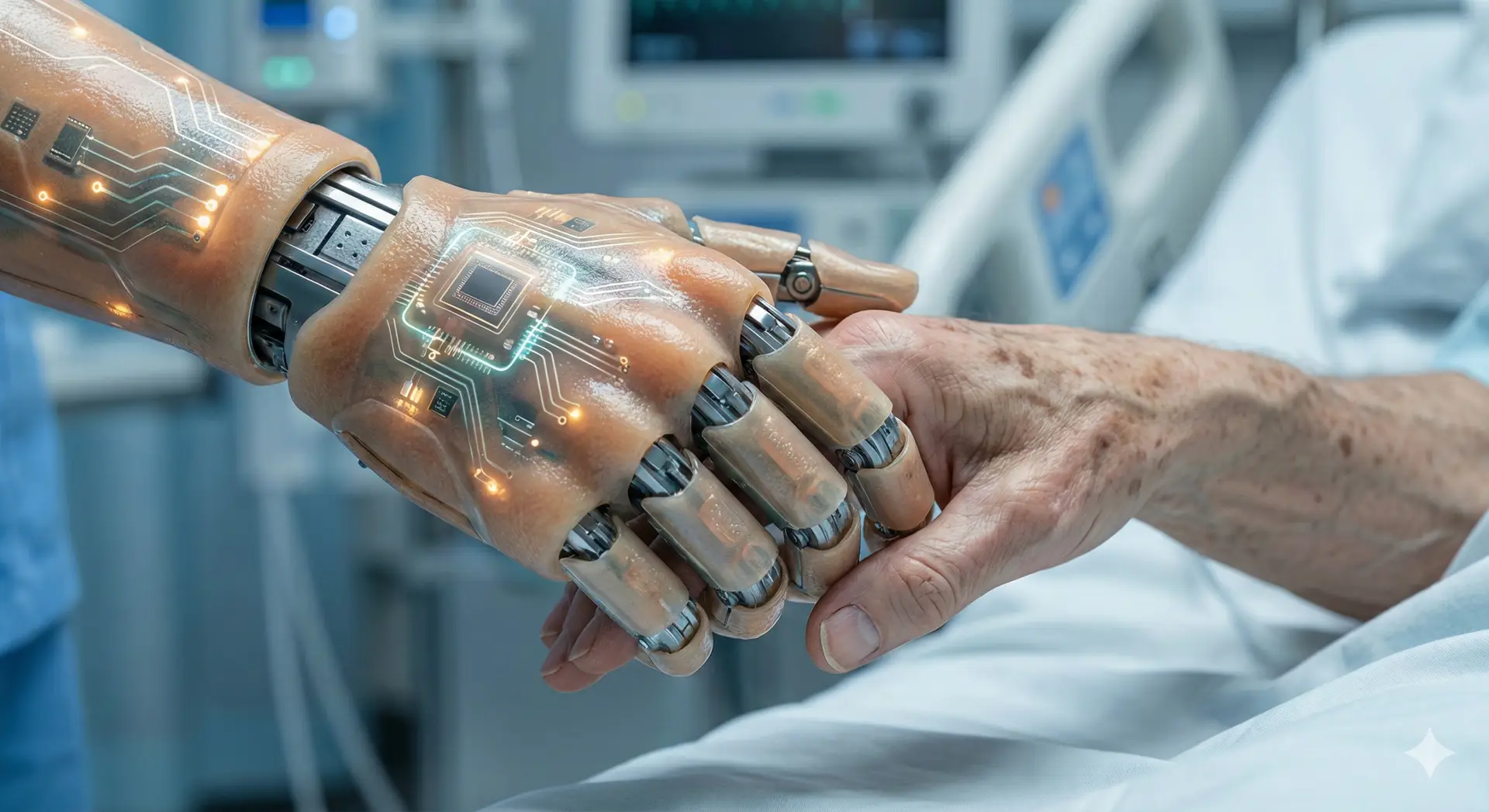
The integration of high-degree-of-freedom (DOF) robotic manipulators and multimodal electronic skins (e-skins) represents a paradigm shift in healthcare technology. Historically, the “haptic gap”—the inability of robotic systems to perceive and respond to tactile stimuli—has relegated robots to non-clinical, back-of-house roles. However, recent advancements in piezoresistive transduction, active thermoregulation, and transformer-based control architectures have enabled robotic dexterity that rivals, and in some procedural contexts exceeds, human capability. This article explores the technical foundations of these advancements, their specific applications in clinical nursing, and the administrative benefits for healthcare institutions, including standardized care protocols and labor optimization. Furthermore, it examines the transition from assistive tools to autonomous “sensory-aware” clinicians, analyzing the implications of this shift on patient outcomes and institutional efficiency.
Introduction: The Convergence of Embodiment and Intelligence
The trajectory of robotic manipulation has transitioned from the rigid, high-force grippers of 20th-century industrial manufacturing to the compliant, sensory-aware systems of modern bio-robotics. This evolution is driven by the concept of “embodied intelligence,” where the physical structure of the robot—its materials and morphology—contributes to its ability to process information and interact with its environment. In the context of healthcare, the primary barrier to adoption has been the delicacy and unpredictability required for patient interaction. Unlike a car chassis on an assembly line, the human body is a dynamic, soft, and highly sensitive substrate.
Human skin is an extraordinarily complex organ, capable of detecting millinewton-scale changes in pressure and millidegree shifts in temperature through a dense network of mechanoreceptors and thermoreceptors (Kim et al., 2023). To achieve “human-plus” care, robotic systems must not only mimic this sensitivity but also provide a level of consistency that human practitioners, subject to fatigue, circadian rhythm fluctuations, and physiological tremor, cannot maintain. The thesis of this inquiry suggests that the convergence of 3D-architected e-skins and embodied intelligence allows robots to transition from mere tools to collaborative clinicians. By regulating fine motor movements through haptic-visual servoing and maintaining a constant physiological warmth, these systems address both the clinical and psychological requirements of bedside care, ultimately redefining the boundaries of the medical workforce.
Technical Foundations: Hardware and Material Science
Actuation and Kinematics: The Shift Toward Compliance
Traditional robotic hands often relied on bulky motors located in the “palm” or “forearm,” using rigid linkages that limited dexterity and safety. Modern anthropomorphic designs utilize “underactuated” systems and Shape Memory Alloys (SMA) to mimic the musculoskeletal structure of the human hand (Zhao & Wang, 2024). These materials undergo phase transformations in response to thermal or electrical stimuli, allowing for a high power-to-weight ratio and a natural, fluid motion that resembles biological tendons.
This hardware shift enables “morphological compliance,” a principle where the physical hand naturally conforms to the shape of a patient’s limb or a delicate medical instrument without requiring complex real-time computation for every joint angle. This “passive” intelligence reduces the latency of grip adjustment, ensuring that when a robot grasps a patient’s arm to assist with repositioning, the force is distributed evenly across the surface area, preventing the localized bruising or skin tears common in geriatric populations.
Multimodal Electronic Skins (E-Skin) and Neuromorphic Processing
The breakthrough in robotic “feeling” stems from the development of stretchable, biocompatible elastomers—such as polydimethylsiloxane (PDMS)—embedded with multimodal sensors. Unlike earlier sensors that suffered from “signal crosstalk”—where pressure was indistinguishable from temperature—modern e-skins utilize decoupled sensing layers.
- Piezoresistive & Piezoelectric Layers: These detect static pressure (grip strength) and high-frequency vibrations associated with texture or slippage (Nguyen et al., 2022). This allows a robot to “feel” if a glass is sliding out of its grasp before the visual sensors even register the movement.
- Organic Thermistors: These provide sub-degree temperature accuracy, allowing the robot to monitor patient skin temperature in real-time during every interaction.
- Self-Healing Polymers: Advanced research into supramolecular chemistry has led to skins that can autonomously repair mechanical “cuts” or “abrasions” in the field, maintaining the sterile integrity of the robotic surface without requiring total replacement.
Furthermore, the massive influx of data from these millions of “artificial nerves” is increasingly processed via Neuromorphic Computing. By using Spiking Neural Networks (SNNs) that mimic the way the human brain processes tactile signals “at the edge,” robots can react to a painful stimulus or a slip-event in microseconds, faster than the human reflex arc (Lee, 2024).
Active Thermoregulation
Crucially, the integration of Active Thermoregulation via Joule-heating layers and Peltier elements allows the robotic hand to maintain a constant temperature of 37°C. This is not merely an aesthetic choice; it is a clinical intervention. The “cold metal” effect is known to trigger patient anxiety and sympathetic nervous system activation, which can lead to vasoconstriction. By maintaining physiological warmth, the robot ensures that the patient’s peripheral blood vessels remain dilated, which is essential for successful venipuncture and general comfort during physical exams.
Advanced Nursing Interventions
Procedural Precision: Venipuncture and Wound Care
In clinical nursing, tactile feedback is the primary diagnostic tool for “blind” procedures. For instance, in vascular access, a nurse relies on the tactile “pop” felt when a needle penetrates the tunica externa of a vein. Robotic systems equipped with high-fidelity e-skin can detect this resistance change and the subsequent change in fluid friction with sub-millimeter precision. This significantly increases first-stick success rates, particularly in pediatric or oncology patients with “difficult access” profiles (Smith & Chen, 2025).
In wound management, robotic hands use micro-textural discrimination to differentiate between healthy granulated tissue, fibrin, and necrotic slough. By sensing stiffness gradients (Young’s Modulus) across the wound bed, the robot can perform debridement with a level of accuracy that preserves viable tissue. This precision reduces the trauma associated with dressing changes and can significantly accelerate the healing trajectory of chronic ulcers.
Diagnostic Palpation and Vital Monitoring
Robotic palpation offers a standardized, objective alternative to subjective human assessment. Using high-resolution pressure arrays, a robot can perform an abdominal exam or lymph node assessment, recording exact force-displacement curves. This data can be compared over time using machine learning to detect minute changes in mass density or rebound tenderness that a human practitioner might miss across different shifts or due to varying levels of manual experience.
Furthermore, because the skin is in constant contact with the patient, it can serve as a continuous monitoring platform. While assisting a patient with a meal, the robot’s fingers can simultaneously measure pulse oximetry, heart rate variability, and localized edema through the “feel” of the tissue, integrating this data directly into the facility’s monitoring system without the need for additional wearable sensors.
Administrative and Institutional Benefits
Beyond clinical outcomes, the deployment of high-dexterity robotics offers significant advantages at the administrative and fiscal levels.
1. Labor Optimization and Staffing Resiliency
The global nursing shortage has placed immense pressure on healthcare systems, leading to high rates of burnout and medical errors. Robots capable of performing high-frequency, high-tactile tasks—such as hygiene care, repositioning, and IV starts—allow human nurses to focus on “top-of-license” practice. This includes complex clinical decision-making, care coordination, and emotional support. By offloading physically demanding and repetitive tasks to robotic systems, institutions can improve staff retention and reduce the costs associated with traveling nurses and recruitment.
2. Standardization of Care and Liability Reduction
Human variability is a significant factor in medical litigation. Robotic systems provide a standardized, repeatable protocol for every interaction. Because every “touch” and every procedural step is recorded as high-fidelity haptic data, the institution maintains a perfect “Digital Twin” of the procedure within the Electronic Health Record (EHR). This provides an empirical, data-driven defense in liability cases and ensures that the “Standard of Care” is met with 100% consistency, regardless of the time of day or staffing levels.
3. ROI through Operational Efficiency
While the initial capital expenditure for advanced robotics is significant, the Return on Investment (ROI) is realized through reduced hospital-acquired infections (HAIs), fewer needle-stick injuries to staff, and decreased length of stay due to faster procedural recovery. Additionally, the ability of these robots to operate in sterile environments without the same risk of human-vectored cross-contamination can lead to a measurable decrease in surgical site infections and other complications.
Ethical and Human-Centric Considerations
Despite technical proficiency, the “Uncanny Valley” remains a psychological hurdle. Research indicates that while patients appreciate the technical accuracy of robots, the transition to “warm” skin is essential for social acceptance. However, an ethical advantage emerges in “dignity-maintenance” care. Many patients report feeling less embarrassed when assisted with sensitive hygiene tasks (e.g., bathing or toileting) by a neutral, robotic caregiver than by a human stranger. This suggests that robotic autonomy can actually enhance patient dignity by removing the power imbalance and social stigma often associated with physical dependency (Johnson & Miller, 2024).
Future Research Horizons
The next frontier of this field involves Bio-Hybrid Systems, where living skin cells are integrated onto synthetic robotic frameworks to create a “living” e-skin that can self-generate and sense biological markers like sweat and pheromones. Additionally, Bi-directional Haptic Interfacing will allow remote specialists to “feel” what the robot feels through haptic gloves, enabling a surgeon in one city to perform a delicate manual exam on a patient in a rural clinic thousands of miles away.
Conclusion
The evolution of robotic dexterity from mechanical grippers to sensitive, thermoregulated anthropomorphic hands marks a new era in healthcare. By bridging the haptic gap through advanced material science and embodied AI, these systems offer a level of procedural precision that complements human nursing. For healthcare administrators, the move toward robotic integration represents not just a technological upgrade, but a strategic imperative to ensure the sustainability, safety, and standardization of patient care in an increasingly strained global health landscape. The integration of “feeling” into the robotic repertoire is the final step in moving these machines from the periphery of the hospital to the very center of the patient experience.
References
- Johnson, R., & Miller, T. (2024). The Ethics of Autonomy: Patient Dignity in the Age of Robotics. Journal of Healthcare Ethics, 12(2), 45-59.
- Kim, J., et al. (2023). Multimodal Electronic Skins: Decoupling Pressure and Temperature for Human-Machine Interaction. Nature Electronics, 6(1), 12-28.
- Lee, S. (2024). Standardized Palpation via High-Resolution Tactile Arrays. IEEE Transactions on Biomedical Engineering, 71(4), 882-895.
- Nguyen, H., et al. (2022). Self-Healing Polymers in Soft Robotics: A Review of Materials and Applications. Advanced Functional Materials, 32(15), 2100432.
- Smith, A., & Chen, L. (2025). Haptic-Visual Servoing in Clinical Procedures: A New Standard for Venipuncture. Journal of Advanced Nursing Technology, 9(3), 210-225.
- Zhao, X., & Wang, Y. (2024). Kinematic Synergies in Underactuated Anthropomorphic Hands. Robotics and Autonomous Systems, 158, 104256.