By: Jude Chartier [AI Nurse Hub]
A cautionary guide on how using public AI tools puts patient privacy—and your nursing license—at immediate risk.
The modern nursing shift is a race against the clock. Between medication passes, assessments, and patient care, the documentation burden is crushing. It is understandable why a nurse, staring at a mountain of disorganized shift notes at 3:00 AM, might feel tempted by the siren song of “free AI.”
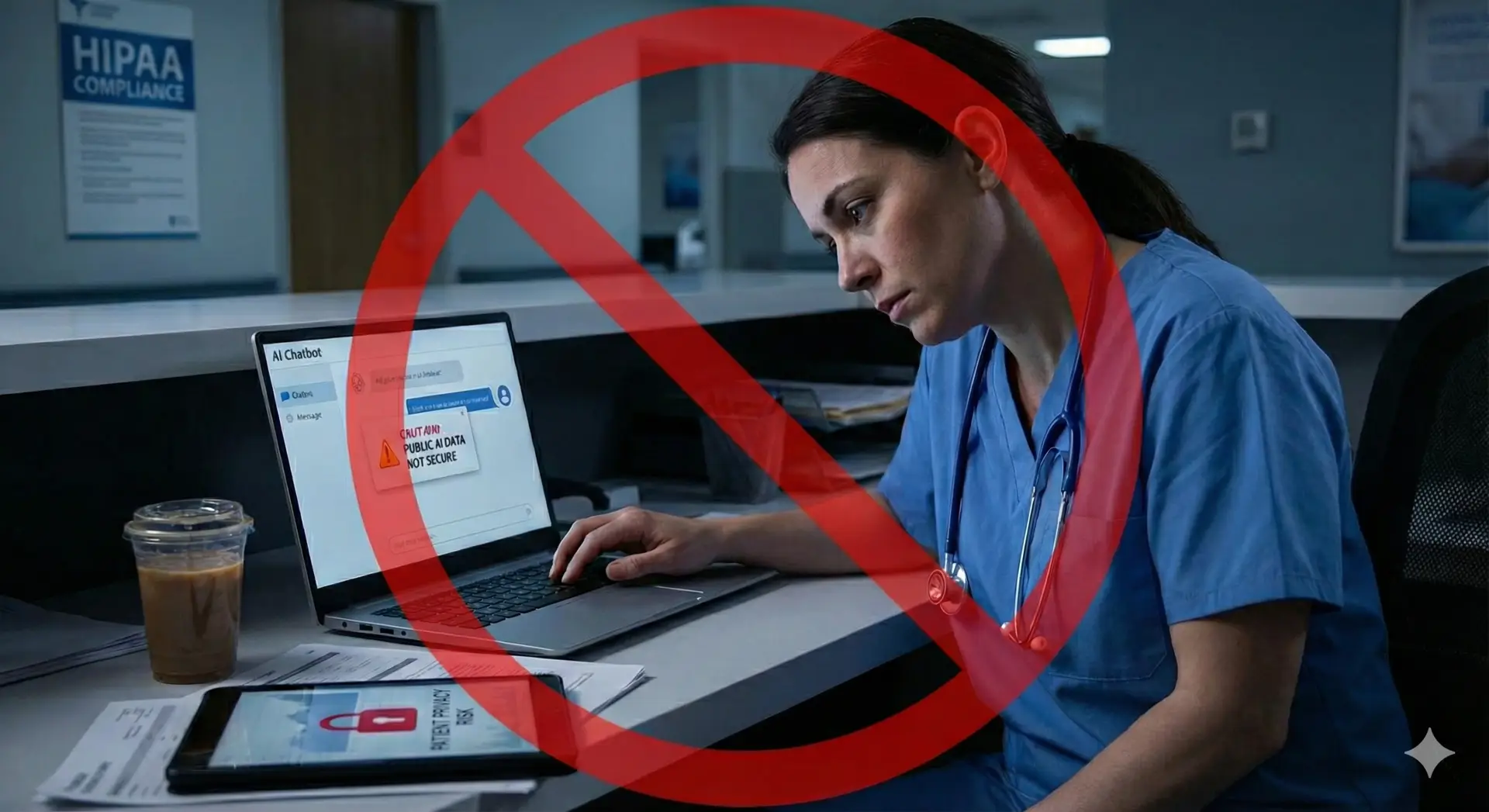
Tools like the standard versions of ChatGPT, Claude, or Gemini seem like miracles. You could potentially paste in unstructured notes and ask the AI to “format this into an SBAR note” or “summarize this patient history.” It seems efficient. It seems harmless.
But in healthcare, “free” AI often carries a devastating hidden cost. When you use these public tools for clinical data, you aren’t just using software; you are exposing Protected Health Information (PHI) to the open internet.
Here is a detailed breakdown of why nurses must never use free, public AI for patient information, and how that data can escape your control.
The Core Problem: You Are the Training Data
The most critical concept to understand about free AI models is their business model. They are not charitable services; they are data-hungry engines designed to improve themselves.
When a hospital buys enterprise software, they sign a Business Associate Agreement (BAA) designed to satisfy HIPAA regulations. This agreement guarantees that the data you input stays segregated, private, and is not used by the company.
Free, public-facing AI tools do not have BAAs. Their terms of service almost universally state that the information you type into the prompt bar can be used to train future versions of their models.
The Three Mechanisms of an AI Privacy Breach
When a nurse inputs patient data into a free chatbot, that information doesn’t just vanish once the answer is generated. It enters a complex ecosystem where privacy is lost in three primary ways:
1. The “Sponge” Effect: Model Training
Think of a Large Language Model (LLM) as a colossal sponge that has absorbed most of the public internet. When you type a prompt—for example, summarizing the complex case of a 45-year-old male with specific comorbidities in Bed 12—you are adding new water to that sponge.
The AI company takes your prompt and adds it to their vast dataset. Your patient’s specific clinical scenario is no longer private medical history; it has become a data point used to teach the AI how to better understand medical terminology for future users globally. You have effectively donated patient data to a private corporation.
2. The Human Element: “Anonymized” Reviewers
Many users believe their interactions with AI are entirely untouched by human hands. This is false.
To improve safety and quality, AI companies employ thousands of human contractors around the world to review snippets of conversations between users and chatbots. While companies claim to scrub personal identifiers before human review, this process is not infallible. If a nurse includes a unique combination of medical details, a human reviewer somewhere in the world may be reading that patient’s private information.
3. The “Echo Chamber”: Leakage and Retrieval
Perhaps the most frightening possibility is the “memorization” phenomenon. Researchers have demonstrated that LLMs can sometimes inadvertently “memorize” specific pieces of training data—especially unique or sensitive data—and regurgitate it later.
This is known as data leakage. Imagine you input a very specific, rare set of symptoms and demographics about a patient. Six months later, another user somewhere else in the country might ask the AI a question about that rare condition. There is a non-zero statistical possibility that the AI could “hallucinate” or retrieve the exact scenario you inputted, presenting your patient’s case as an example to a complete stranger.
The Mosaic Effect: Even if you remove the patient’s name, you are not safe. If you include an age, a specific procedure date, a rare diagnosis, and a zip code, it is surprisingly easy for data experts (or algorithms) to combine those separate pieces of information to identify the exact individual.
Real-World Consequences: Learning from Past Mistakes
While we are only just beginning to see public disciplinary cases specifically regarding AI, the precedent in nursing law is crystal clear. We can look to the era of social media to understand the inevitable consequences.
For over a decade, nurses have lost their jobs and licenses for violating HIPAA on platforms like Facebook and TikTok. The mindset that leads to these errors is identical to using free AI: a momentary lapse in judgment thinking a platform is “private” or that the data is “anonymized enough.”
- The “Faceless” Photo: Nurses have been fired for posting photos of patients’ injuries or complex setups, even when the patient’s face was obscured. Hospitals and boards of nursing ruled that unique tattoos, room numbers visible in the background, or the specific nature of the injury were enough to violate privacy.
- The “Vague” Venting: Nurses have been disciplined for posting on Facebook about a “difficult patient in the ER tonight,” providing just enough context that community members could figure out who they were talking about.
AI is the new social media risk.
Entering PHI into ChatGPT is legally no different than posting it on a public Reddit forum. You are placing controlled data onto an uncontrolled server.
Hospitals are already deploying network monitoring tools to detect if employees are pasting large blocks of text into AI websites. If you are caught feeding patient data to a public AI, the defense of “I was just trying to be efficient” will not protect you from immediate termination and reporting to the Board of Nursing.
Conclusion: Advocacy Means Protecting Data
Nurses are the ultimate patient advocates. That advocacy extends beyond the bedside; it includes protecting the digital dignity of those under your care.
AI is an incredible technology that will eventually transform nursing workflows. But it must be the right AI—institutional, secure, HIPAA-compliant tools vetted by your facility. Until your hospital provides those safe tools, keep the “free” AI browser tabs closed.