By: Jude Chartier RN / AI Nurse Hub
Date: February 3, 2026
Abstract
The traditional paradigm of social robotics in healthcare has historically prioritized “obedient” compliance and passive comfort, often resulting in short-term engagement with limited therapeutic depth. However, emerging research from the University of Bristol suggests that the future of therapeutic AI lies in “active mirroring,” a concept derived from Equine-Assisted Interventions (EAI). This article explores the transition from compliant machines to bio-reflective social robots that provide productive challenges to patients through selective resistance. For nursing professionals, this shift promises a radical reduction in emotional labor and the introduction of “emotional vitals” as a new diagnostic standard. From an administrative perspective, this article analyzes the financial trajectory of such technology, arguing that while initial capital expenditures and integration costs are significant, the potential for reduced staff burnout, improved HCAHPS scores, and enhanced patient throughput presents a compelling long-term financial case for value-based purchasing.
Introduction
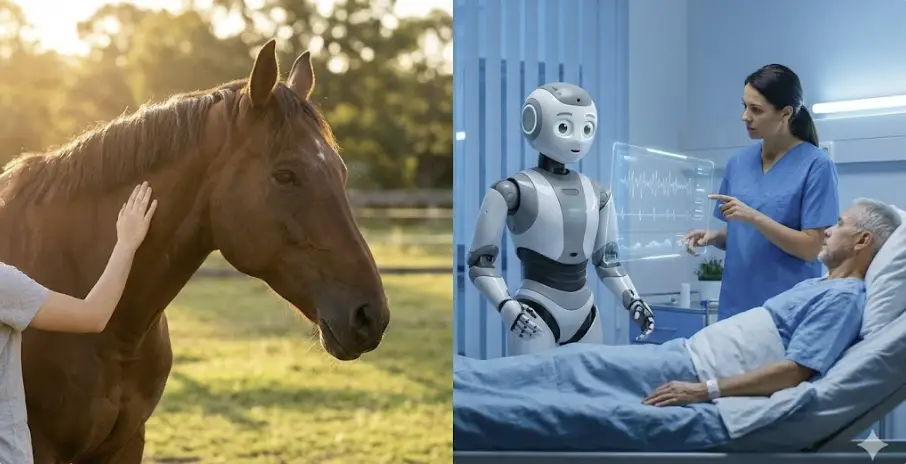
In the current healthcare landscape, social robots such as Paro (the therapeutic seal) and Pepper have primarily served as “compliant companions,” designed to offer unconditional comfort and predictable, repetitive interactions. While these tools are effective for immediate mood elevation in geriatric and pediatric settings, this “compliance paradigm” often fails to foster long-term emotional resilience or sophisticated self-regulation skills in patients. The robot effectively becomes a crutch rather than a coach. A transformative study led by Ellen Weir at the University of Bristol, presented at the CHI 2025 conference, proposes a radical shift: designing robots that mimic the “selective compliance” and boundary-setting behaviors of therapy horses (Weir et al., 2025).
This article examines how integrating “horse sense”—the biological ability to respond dynamically and sometimes resistantly to a human’s autonomic nervous system (ANS)—into AI-driven robotics will redefine therapeutic environments. For the nursing profession, this represents a pivotal evolution from being the primary emotional stabilizer in a unit to a “therapeutic conductor.” In this new role, the nurse oversees sophisticated bio-reflective feedback loops where the robot acts as an intermediary, teaching the patient to regulate their own physiological stress before human intervention is even required.
Theoretical Framework: The Equine Model and “Productive Anxiety”
The foundation of this new robotic generation is Equine-Assisted Intervention (EAI). Unlike domesticated pets that often offer unconditional affection, horses are prey animals with highly sensitive nervous systems. They are biologically wired to detect subtle human non-verbal cues, including heart rate variability (HRV), cortisol-induced muscle tension, and respiratory shifts (Jain & Gardner-McCune, 2025). In a therapeutic setting, a horse acts as a “living mirror”; if a patient is agitated, loud, or emotionally dysregulated, the horse may refuse to move, turn its back, or exhibit signs of stress. This creates what researchers call “productive anxiety”—a state where the patient must lower their internal “volume” to achieve their goal of interaction.
Weir et al. (2025) argue that therapeutic robots should adopt this “active co-worker” status. By introducing selective non-compliance—where the robot withholds a response or exhibits “withdrawn” body language until the user exhibits a calm physiological state—patients are forced into a state of self-awareness. This process facilitates neuroplasticity by providing immediate, non-judgmental, and undeniable feedback on the patient’s internal state. For populations dealing with Post-Traumatic Stress Disorder (PTSD) or neurodivergent conditions like Autism Spectrum Disorder (ASD), this tactile and visual biofeedback loop bypasses the cognitive load of traditional talk therapy, allowing for physiological “re-tuning” (Weir et al., 2025).
Current State of AI and Healthcare Integration
The transition toward bio-reflective robotics is supported by rapid advancements in affective computing and multimodal sensor fusion. Pioneers like Rosalind Picard have established that “Emotional AI” can now detect skin conductance, facial micro-expressions, and even blood volume pulse through standard camera lenses with high accuracy (Picard, 2023).
Multimodal Fusion and Mechanical Empathy
Modern AI systems no longer rely on a single data point. Instead, they utilize “Multimodal Fusion,” combining voice tonality analysis, posture tracking via LiDAR, and real-time HRV monitoring. Furthermore, the integration of Large Language Models (LLMs) allows these robots to provide context-aware verbal feedback that explains why the robot is resisting. For example, a robot might say, “I feel you are very tense right now; I am going to wait until we both take a deep breath before we continue our walk.”
The emerging frontier involves “mechanical empathy,” where the robot’s physical architecture is designed to communicate through subtle kinesis. This includes robotic “ears” that swivel toward sounds or “breathable” chest plates that expand and contract to model rhythmic breathing for the patient. Current market leaders like ElliQ and Miko are beginning to incorporate these sensors, but the Bristol research suggests the next step is to program these units with the “will” to say no (Weir et al., 2025).
Impact on Nursing Care and Clinical Practice
The introduction of bio-reflective robots marks the most significant evolution in nursing informatics since the transition to Electronic Health Records (EHR).
1. Mitigation of Emotional Labor and Compassion Fatigue
Nursing is characterized by high levels of “emotional labor,” defined as the effort required to manage one’s own feelings to provide a calm presence for patients. In psychiatric, emergency, and pediatric units, this labor often leads to compassion fatigue. Bio-reflective robots can handle the “heavy lifting” of initial emotional de-escalation. By allowing the robot to serve as the primary feedback mechanism for an agitated patient, nurses can step back and observe the interaction, stepping in only when the patient has reached a baseline level of regulation. This shift preserves the nurse’s emotional bandwidth for high-stakes clinical decision-making (Journal of Advanced Nursing, 2024).
2. The Introduction of “Emotional Vitals”
Historically, nurses have assessed a patient’s emotional state subjectively (e.g., “patient appears anxious”). Bio-reflective robots transform this into objective data. These robots can provide a continuous stream of “emotional vitals”—data points such as “Recovery Time After Agitation” or “Daily Self-Regulation Success Rate.” This data can be integrated directly into the EHR, allowing nurses to identify patterns that might precede a clinical crisis, such as a sudden drop in a patient’s ability to co-regulate with the robot (Nurse.org, 2025).
3. Case Study: The Neuro-Rehabilitation Unit
Imagine a neuro-rehabilitation unit where a patient is recovering from a Traumatic Brain Injury (TBI). The patient frequently becomes frustrated during physical therapy. A bio-reflective robot accompanies the patient; when it senses the patient’s heart rate climbing past a certain threshold, the robot pauses and refuses to move forward, lowering its “head” in a gesture of equine-like submission. The nurse, seeing this on a central monitor, knows the patient is hitting a physiological limit before the patient even realizes it, allowing for a proactive rest period rather than a reactive emotional outburst.
Administrative and Financial Perspectives: The ROI of Retention
From a management and C-suite perspective, the implementation of bio-reflective robotics is an investment in human capital as much as technology.
Positive Financial Impacts and Value-Based Care
- Drastic Reduction in Turnover Costs: The primary driver of hospital operational deficits is nurse turnover. Replacing a single specialized nurse can cost an organization between $52,000 and $92,000 (Nurse.org, 2025). If bio-reflective robots reduce burnout-related resignations by even 15%, the system pays for itself within two fiscal years.
- HCAHPS and Patient Satisfaction: Patient experience scores (HCAHPS) directly impact Medicare reimbursements. Patients who feel they have consistent, interactive support—even from a robot—report higher satisfaction with their “care environment.” Furthermore, by reducing unit noise and agitation through better patient self-regulation, the overall healing environment improves for all occupants.
- Improved Throughput and Length of Stay (LOS): In rehabilitation settings, the ability to practice self-regulation 24/7 with a robot can accelerate progress. Shortening the LOS by even 0.5 days across a facility can result in millions of dollars in increased capacity (McKinsey, 2024).
Financial Challenges and Hidden Costs
- Capital Expenditure vs. Operational Expense: The initial “sticker shock” of high-fidelity bio-reflective units is significant. Administrators must move these costs from “disposable equipment” budgets to “long-term infrastructure” investments.
- The Cybersecurity Tax: Processing bio-sensitive data requires “Edge Computing”—where data is processed on the robot rather than the cloud—to maintain HIPAA compliance. This requires a more sophisticated IT infrastructure and higher ongoing maintenance costs.
Ethical Considerations: The “Authenticity Gap”
The primary ethical challenge for nurses is the “authenticity gap.” There is a risk that a patient might feel manipulated if they realize a robot’s “resistance” is a programmed simulation rather than a genuine feeling (Turkle, 2017). Furthermore, the “uncanny valley” effect—where robots that look too human but act slightly “off” cause revulsion—is a major concern. Using animal-inspired designs (like horses) bypasses this issue, as humans are more accepting of non-human behaviors from non-human-looking machines. Nurses must act as the “ethical guardians” of this technology, ensuring that the robots are calibrated to the individual patient’s trauma history so that “productive anxiety” does not become “re-traumatization.”
Conclusion
The evolution of social robotics from passive “pets” to active “mirrors” represents a fundamental paradigm shift in healthcare delivery. By adopting the behavioral intelligence and “selective compliance” of therapy horses, these AI systems offer a powerful new tool for emotional regulation, patient assessment, and staff support. For the nursing profession, this technology does not signal replacement, but rather liberation. It provides a path toward a sustainable practice where machines handle the repetitive, exhausting cycles of emotional de-escalation, allowing human caregivers to return to the “heart” of nursing: high-level, compassionate clinical care that only a human can provide.
References
Dautenhahn, K. (2022). Socially Intelligent Robots: Dimensions of Human–Robot Interaction. Springer Nature.
IEEE Spectrum. (2024). The Rise of Bio-Inspired Robotics in Clinical Settings. Retrieved from https://spectrum.ieee.org
Jain, S., & Gardner-McCune, C. (2025). Horse as Teacher: How human-horse interaction informs human-robot interaction. ResearchGate.
https://www.google.com/search?q=https://doi.org/10.13140/RG.2.2.34567.8901
Journal of Advanced Nursing. (2024). The Integration of Social Robotics into Ward-Based Care: A Systematic Review. Wiley.
McKinsey & Company. (2024). The Value of AI in Healthcare: From Administrative Relief to Financial Insight.
Nurse.org. (2025). Robots in Nursing Homes Are Easing The Workload For Nurses. Retrieved from https://nurse.org/news/nursing-home-robots/
Picard, R. W. (2023). Affective Computing: The Next Frontier in Health AI. MIT Press.
Reputation Partners. (2025). AI and Robotics are Essential for Hospital Survival: The Question of Labor. https://www.google.com/search?q=https://reputationpartners.com/ai-robotics-survival/
Turkle, S. (2017). Alone Together: Why We Expect More from Technology and Less from Each Other. Basic Books.
Weir, E., Leonards, U., & Roudaut, A. (2025). “You Can Fool Me, You Can’t Fool Her!”: Autoethnographic Insights from Equine-Assisted Interventions to Inform Therapeutic Robot Design. Proceedings of the CHI Conference on Human Factors in Computing Systems (CHI ’25).
https://www.google.com/search?q=https://doi.org/10.1145/389055339