By:[Jude Chartier RN / AI Nurse Hub]
Date: January 21, 2026
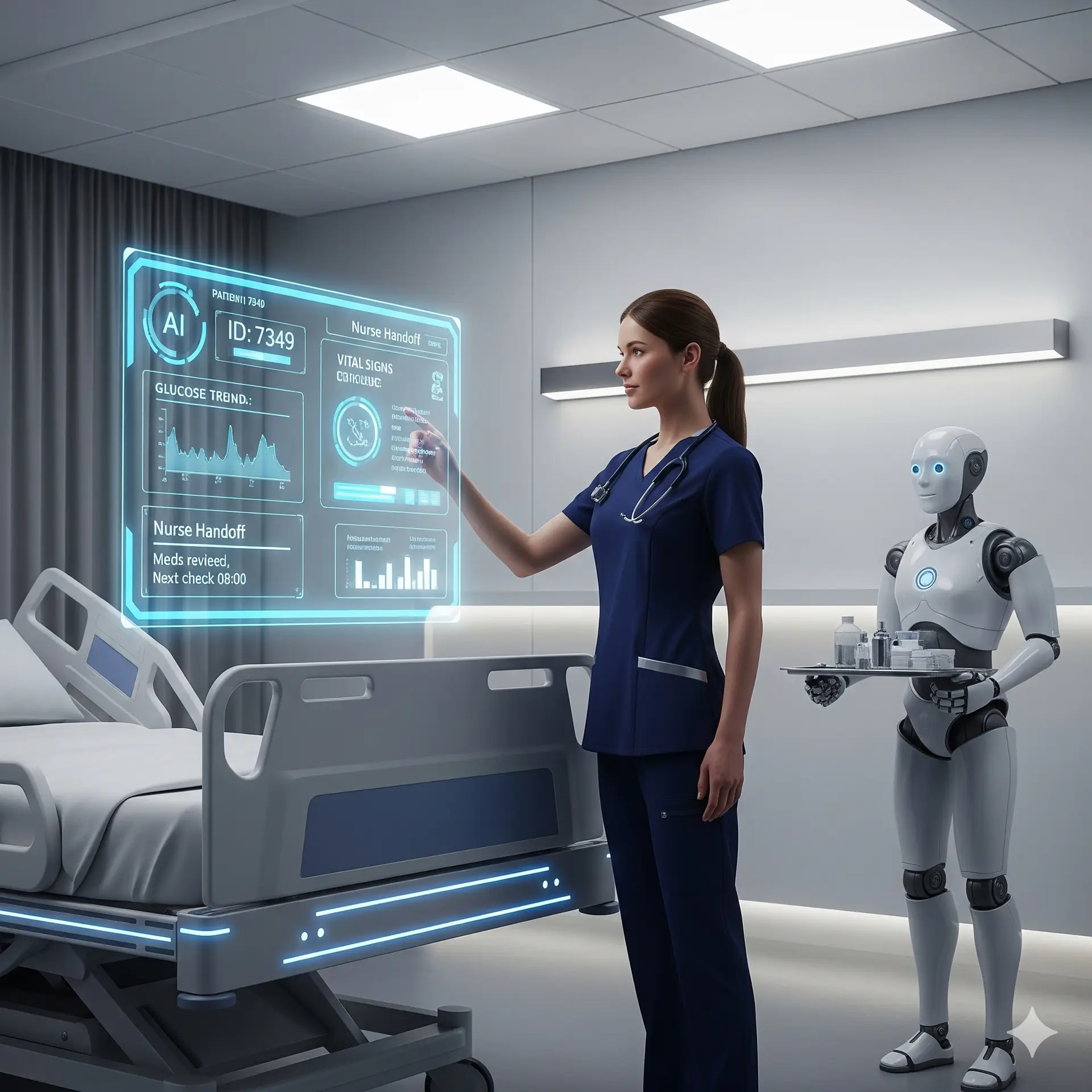
Abstract The transition of care between shifts—the handoff—is a high-acuity period prone to information loss, communication errors, and significant administrative waste. As healthcare systems in 2026 navigate chronic staffing shortages and rising patient complexity, the implementation of artificial intelligence (AI) has transitioned from experimental pilots to core operational infrastructure. This article evaluates the HCA Healthcare and Google Cloud “Nurse Handoff” initiative, which utilizes medical large language models (MedLM) to automate shift-change documentation. By analyzing a potential system-wide reclamation of 10 million hours of nursing time, this study explores the synergy between administrative ROI and clinical safety. However, successful adoption hinges on addressing the “hallucination gap,” professional liability anxieties, and the “efficiency trap” regarding staffing ratios. This research provides a strategic framework for hospital leadership to implement AI as a “cognitive co-pilot,” ensuring technological advancement strengthens, rather than diminishes, the human-centric nature of nursing.
Introduction: The Shift-Change Bottleneck
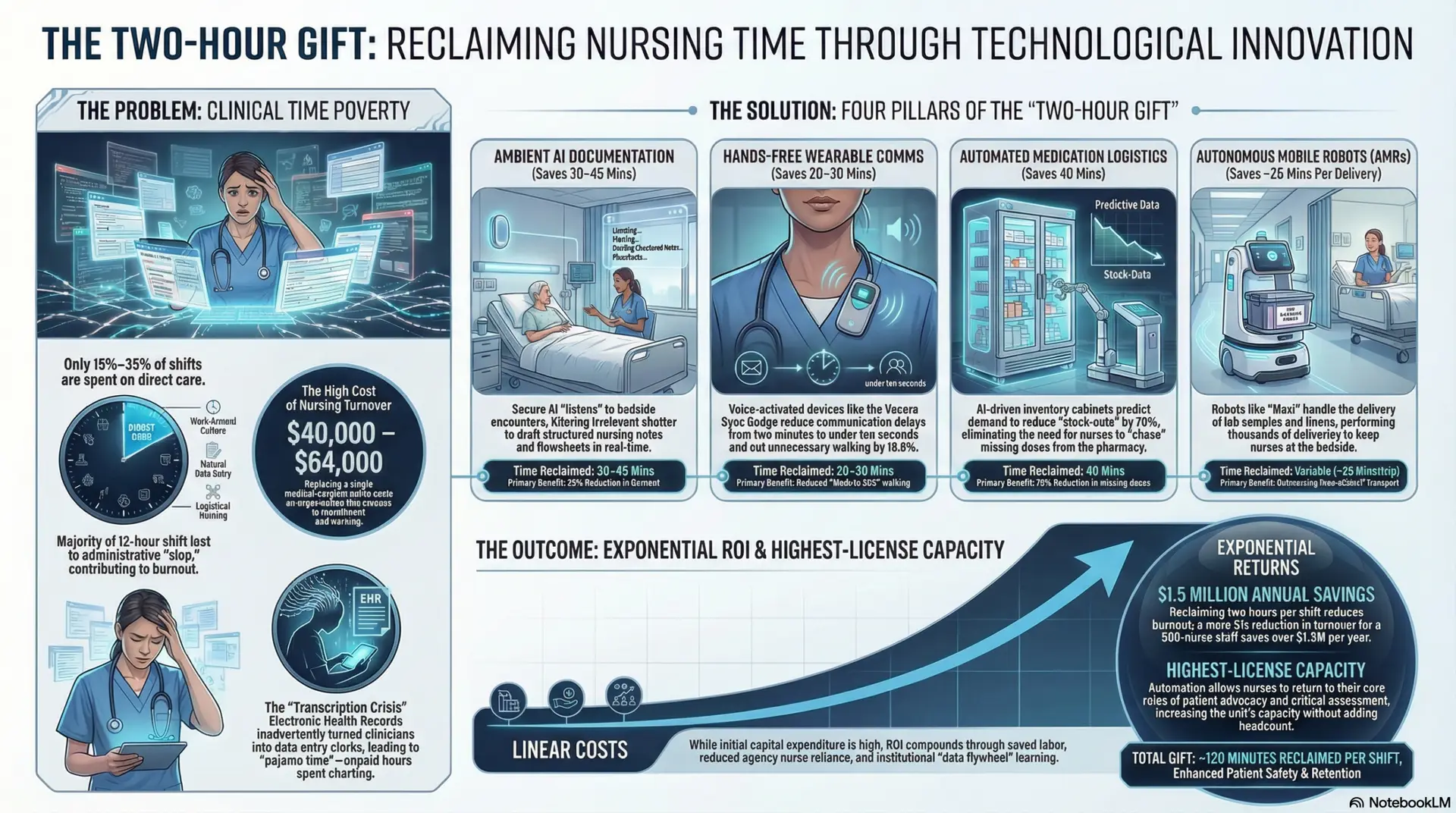
Communication failure during patient handoffs is a leading cause of sentinel events in United States hospitals. Traditional methods rely on “passive” documentation retrieval and “active” memory-based verbal synthesis, a process that averages 40 minutes per nurse, per shift (Google Cloud, 2025). In a large-scale enterprise like HCA Healthcare, which manages approximately 400,000 handoffs weekly, this equates to a massive expenditure of human capital on clerical synthesis rather than direct patient care. As the American Hospital Association (AHA) prioritizes variance reduction in 2026, AI-driven summaries represent a paradigm shift: moving the clinician from the “producer” of data to the “verified editor” of clinical intelligence (AHA, 2025).
The Administrative Value Proposition: ROI and Throughput
For hospital administrators and C-suite executives, the primary driver for AI integration is the “hard ROI” of reclaimed productivity and improved throughput.
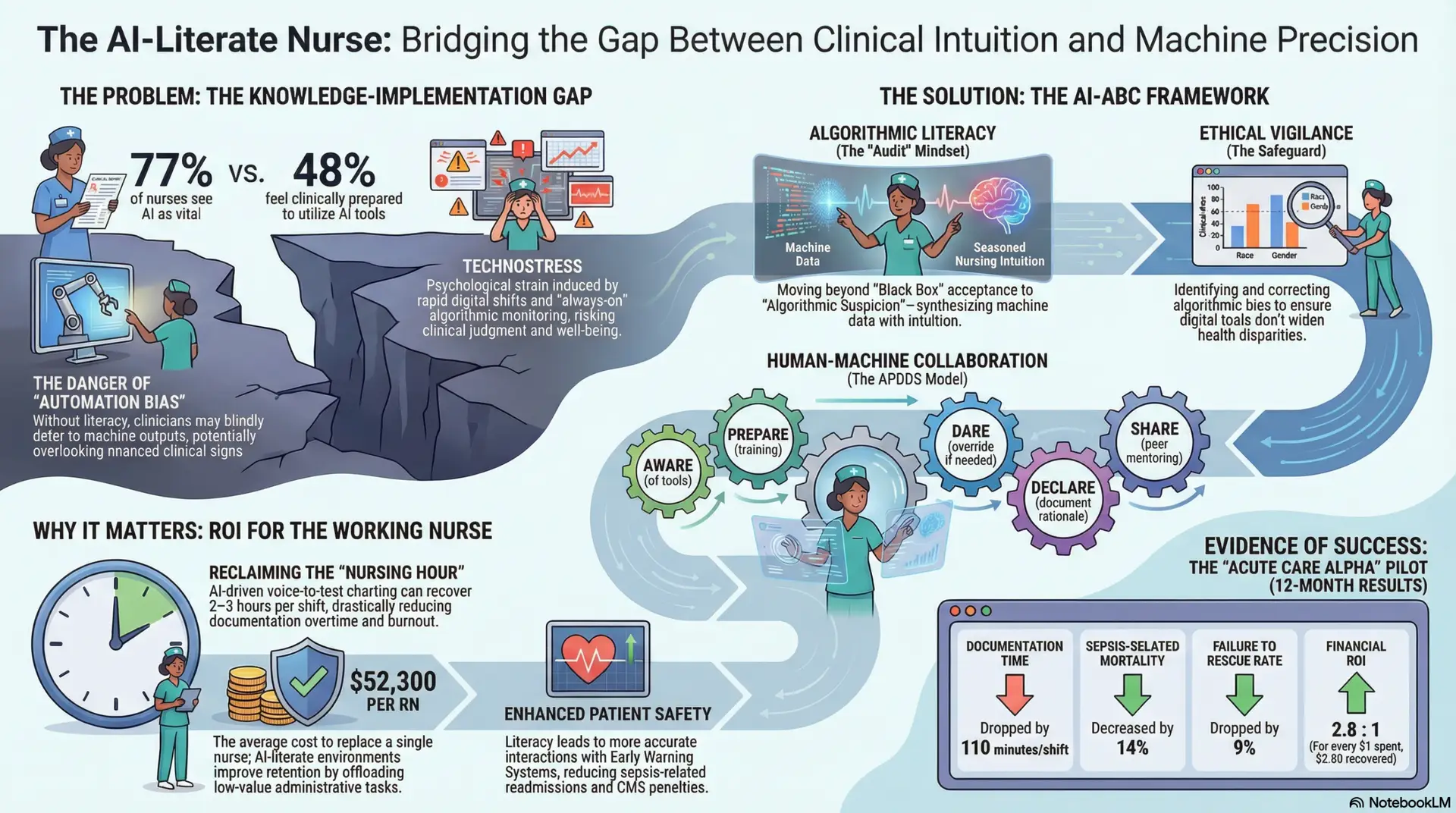
- Reclaiming Productive Hours: HCA Healthcare’s projections suggest that automating the search-and-summarize functions within the EHR can reclaim 10 million hours of nursing time annually (Medium, 2025). This recovery allows for a “top-of-license” redesign, where nurses spend significantly more time on complex clinical reasoning and patient education without increasing labor costs.
- Overtime Reduction: By providing a “first-pass” summary that is 86% factual at the point of origin, AI reduces the “overlap lag” where outgoing nurses remain on the clock solely to finish charting.
- Data-Driven Quality Oversight: Unlike traditional verbal handoffs, AI-generated summaries create a digital trail of what was communicated. This allows administration to audit the quality of care transitions and identify systemic gaps in real-time (Wolters Kluwer, 2026).
The “Pro” Case: Clinical Precision and Safety
The clinical benefits of the HCA/Google Cloud partnership are rooted in the technology’s ability to process massive datasets without fatigue.
- Standardization of Continuity: AI provides a consistent baseline for every handoff, prioritizing vitals, lab trends, and “red-flag” orders. This removes the subjectivity of individual nursing styles, ensuring that critical data points—like a subtle rise in creatinine or a drop in Mean Arterial Pressure (MAP)—are not omitted during a chaotic shift (AHA, 2025).
- Pilot Success Metrics: Data from 2025 pilots indicated a 90% “helpfulness” rating among frontline staff, suggesting that when AI is designed by nurses (the “frontline-first” approach), it achieves high adoption rates (Google Cloud, 2025).
- Nurse-Led Design: By training MedLM on “nurse-sensitive” indicators such as skin integrity, fall risk, and line patency, the technology transcends generic medical summaries and supports actual nursing priorities (Health AI Summit, 2026).
The “Con” Case: Challenges, Hallucinations, and Bias
Despite technical prowess, AI implementation faces significant “socio-technical” barriers.
- The Hallucination Gap: While 86% accuracy is a breakthrough, the remaining 14% represents the “hallucination gap”—instances where the AI may generate plausible but incorrect clinical information, such as misinterpreting a PRN pain medication as a scheduled dose (Health AI Summit, 2026).
- Cognitive and Automation Bias: There is a persistent danger of “lazy verification,” where fatigued nurses may assume the AI summary is correct and fail to cross-check primary source data in the EHR (SullivanCotter, 2026).
- Fragmented Workflows: Integration with legacy EHR systems (e.g., Meditech Expanse) remains a challenge. If the AI-generated draft does not sync seamlessly, it risk creating “dual-documentation,” which increases rather than decreases workload (IntuitionLabs, 2025).
The Workforce Paradox: Staffing Ratios and Liability
The most profound obstacles to AI adoption are rooted in the professional identity and legal protection of the nurse.
- Staffing Ratio Anxiety: Nurses frequently express fear of the “efficiency trap”—the concern that administration will use reclaimed time as a justification to increase nurse-to-patient ratios (Simbo AI, 2026). If a nurse’s administrative burden is halved, administrators may be tempted to increase their patient assignment from 1:4 to 1:5, effectively neutralizing the wellness benefits of the technology.
- The Liability “Double Bind”: Software developers are not licensed clinicians; nurses remain 100% legally liable for any error in a report they sign, even if that error was “hidden” in an AI summary. This creates a high-stakes environment where nurses feel they are being asked to act as “human shields” for algorithmic mistakes (NCBI, 2025).
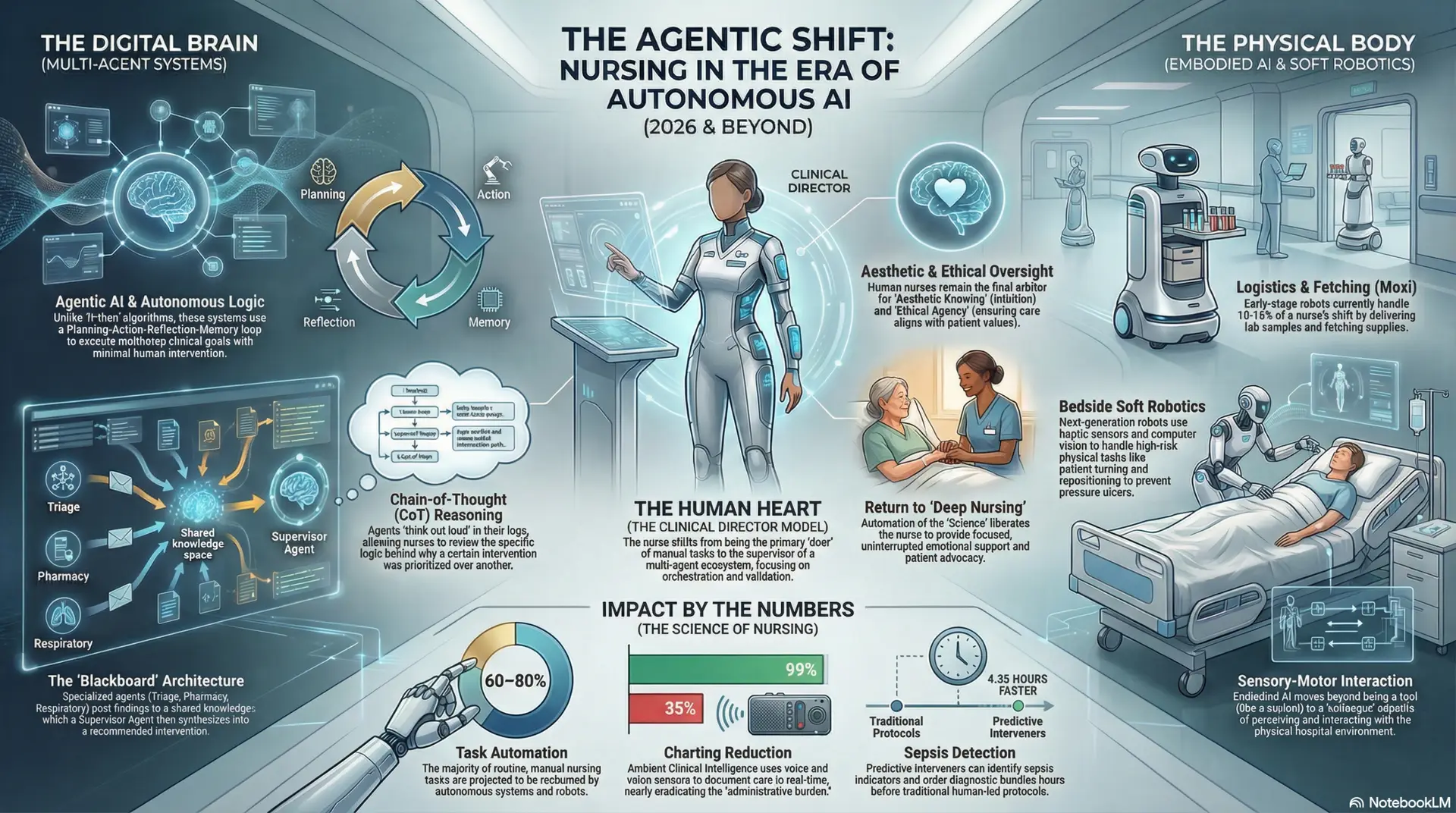
- Autonomy and Deskilling: Over-reliance on AI may lead to “clinical deskilling,” where the nurse’s innate ability to synthesize a patient’s story is replaced by a reliance on an automated narrative, potentially eroding professional intuition (PMC, 2025).
Recommendations for Hospital Leadership
To successfully scale AI-driven handoffs in 2026, administrators must move beyond purely financial metrics and focus on “Trust-Based Implementation”:
- Formal AI Governance: Establish multidisciplinary committees where frontline nurses have veto power over algorithmic changes that impact clinical safety (Wolters Kluwer, 2026).
- Staffing Guarantees: Provide explicit institutional commitments that AI-driven efficiency will be used to improve care quality and nurse retention, not to increase patient loads.
- Liability Frameworks: Develop clear institutional policies that protect nurses who follow “Verify then Sign” protocols, ensuring that the technology acts as a support system, not a legal liability.
Conclusion
AI-generated nurse handoffs represent the most significant operational advancement in acute care since the introduction of the EHR. By reclaiming millions of hours of administrative time, healthcare systems can finally address the root causes of clinician burnout. However, the technology is only as effective as the trust it inspires. Hospital administrators must lead with transparency, ensuring that AI remains a “cognitive co-pilot” that empowers the nurse to return to the bedside, where the “human element” of care remains irreplaceable.
References
American Hospital Association (AHA). (2025). Smarter, safer hospitals: How HCA Healthcare is using AI to redefine patient safety. https://www.aha.org/news/blog/2025-10-16-smarter-safer-hospitals-how-hca-healthcare-using-ai-redefine-patient-safety
Google Cloud. (2025). How nurses are charting the future of AI at America’s largest hospital network. https://cloud.google.com/transform/nurse-handoff-ai-chart-app-hca-healthcare-better-patient-outcomes
Health AI Summit. (2026). The high-stakes handoff gets an AI assist: HCA and Google Cloud pilot AI to streamline nurse handoffs. https://www.health-ai-summit.com/news/the-high-stakes-handoff-gets-an-ai-assist
IntuitionLabs. (2025). AI in hospital operations: 2025 trends, efficiency & data. https://intuitionlabs.ai/articles/ai-hospital-operations-2025-trends
Medium. (2025). Revolutionizing nursing with AI: Google’s latest tool & Rebecca Love’s vision. https://medium.com/the-ai-entrepreneurs/revolutionizing-nursing-with-ai-googles-latest-tool-rebecca-love-s-vision-8e26d7d1723f
NCBI Bookshelf. (2025). 2025 Watch List: Artificial intelligence in health care. https://www.ncbi.nlm.nih.gov/books/NBK613808/
PubMed Central (PMC). (2025). Artificial intelligence in nursing practice: A qualitative study of nurses’ perspectives. https://pmc.ncbi.nlm.nih.gov/articles/PMC12522738/
Simbo AI. (2026). The role of A.I. in transforming nursing workloads and staffing ratios. https://www.simbo.ai/blog/the-role-of-a-i-in-transforming-nursing-workloads-and-staffing-ratios-balancing-efficiency-with-patient-care-2616757/
SullivanCotter. (2026). How AI will shape the future of health care in 2026. https://sullivancotter.com/ai-and-the-future-of-health-care/
Wolters Kluwer. (2026). 2026 healthcare AI trends: Insights from experts. https://www.wolterskluwer.com/en/expert-insights/2026-healthcare-ai-trends-insights-from-experts