By: Jude Chartier / AI Nurse Hub
Date: January 30, 2026
For decades, the career trajectory for a Registered Nurse (RN) was relatively linear: nursing school, bedside care, and perhaps a move into management or advanced practice. But in 2026, a new, highly lucrative path has emerged—one that trades scrubs for software and stethoscopes for semantic analysis.
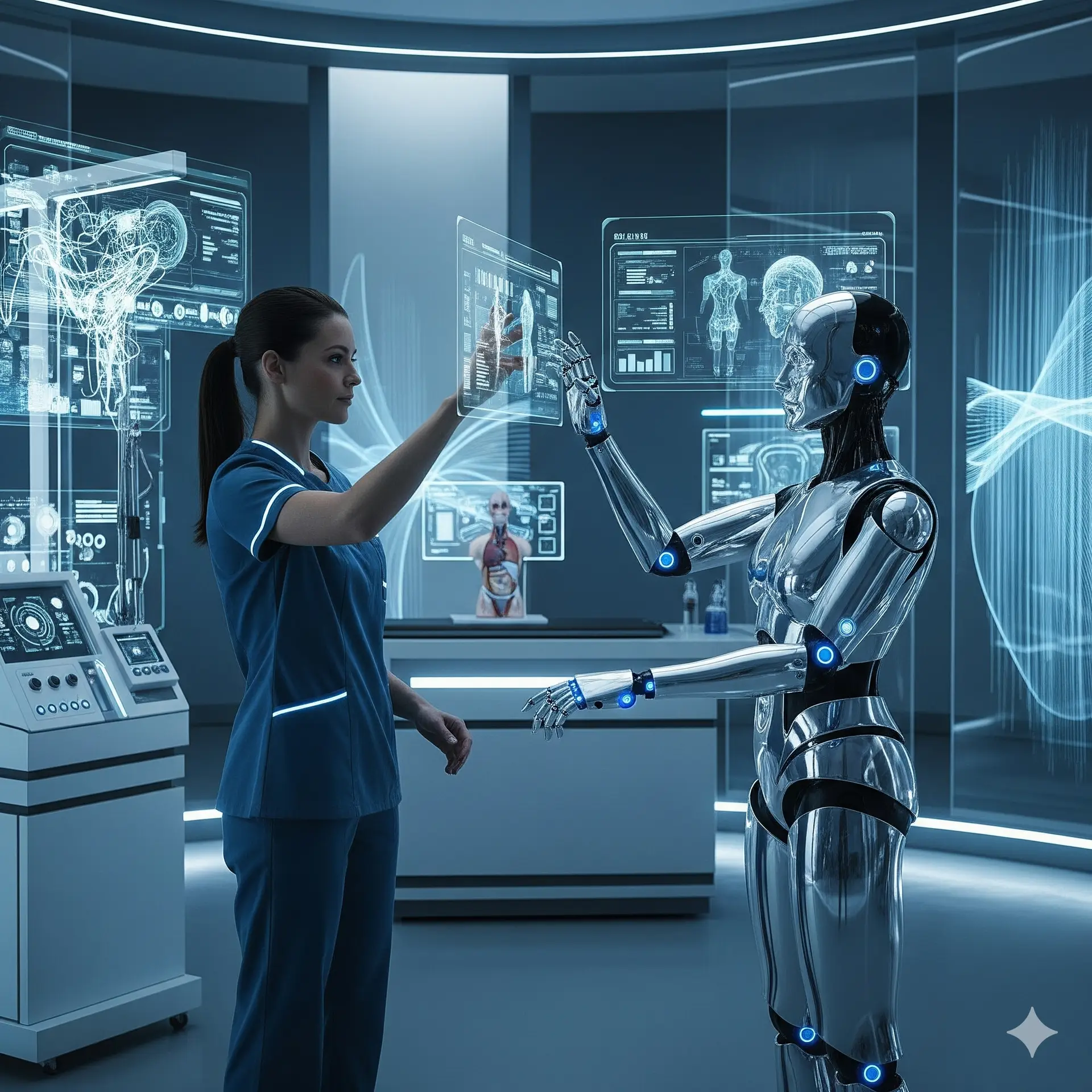
As Artificial Intelligence (AI) and humanoid robotics move from experimental labs to hospital floors, technology giants are realizing a critical truth: engineers cannot build medical tools alone. They need clinical experts to teach the machines.
This realization has sparked a hiring boom for “Nurse Technologists”—clinical professionals who work directly for companies like NVIDIA, Hippocratic AI, and Diligent Robotics to design, train, and safeguard the digital workforce of the future. This isn’t just a niche side-gig; it is a rapidly formalizing career track that capitalizes on the massive exodus of clinicians from the bedside by offering them a way to scale their care to millions of patients at once.
The “Knowledge Gap”: Why Big Tech Needs Nurses
Software engineers are experts at writing code, but they often lack the “tacit knowledge” of nursing—the subtle, unwritten cues that tell a nurse a patient is deteriorating. When tech companies attempt to build medical AI without this nuance, the results can be clumsy or dangerous.
“We saw early AI models that could pass a medical board exam but couldn’t handle a basic patient triage conversation with empathy,” explains a lead recruiter at a major health-tech firm. “That’s where the nurses come in. We aren’t hiring them to code; we are hiring them to be the ‘clinical conscience’ of the AI.”
Without this “conscience,” an AI might technically give the correct medical definition of heart failure but fail to notice that the patient is expressing subtle signs of anxiety or confusion that require a gentler, more reassuring tone. A nurse spots that instantly. By hiring nurses to “train” these models, tech companies are essentially digitizing the bedside manner that has taken the profession a century to perfect.
The New Roles: A Day in the Life of a Nurse in Tech
This emerging field is split into two primary domains: Cognitive AI Training (teaching software to think/speak) and Physical AI/Robotics (teaching robots to move/act).
1. The AI Tutor (RLHF Specialist)
- The Job: Most medical AI, such as the “digital nurses” developed by Hippocratic AI, learn through a process called Reinforcement Learning from Human Feedback (RLHF). In this role, human nurses act as teachers. They engage in thousands of role-play scenarios with the AI, grading its responses on accuracy, safety, and—crucially—empathy. The economic drivers are clear: companies are pitching these AI agents at roughly $9/hour to operate, compared to the $90/hour total cost of a human nurse, making the safety verification by human RNs the critical “trust layer” for adoption.
- The Day-to-Day: A Nurse AI Specialist might spend their morning reviewing transcripts of an AI explaining a congestive heart failure discharge plan.
- Scenario: The AI tells a patient, “You must adhere strictly to a 2000mg sodium limit or you will face immediate readmission.”
- The Correction: The nurse flags this as “technically accurate but therapeutically harsh.” They rewrite the response to be: “Managing salt intake is tough, but keeping it under 2000mg will really help you breathe easier and stay home with your family. Let’s look at some low-salt swaps for your favorite foods.”
- The Result: The AI “learns” that clinical accuracy must be paired with motivational interviewing techniques.
- Key Companies: Hippocratic AI (utilizing the “Polaris” constellation of models), Abridge, Google (DeepMind Health), and specialized agencies like Invisible and Mercor.
2. The Robot Choreographer (Clinical Workflow Informaticist)
- The Job: With the rollout of NVIDIA’s Isaac for Healthcare platform and humanoid robots like Tesla’s Optimus entering pilot phases, nurses are needed to define “safe motion.” These nurses work with roboticists to map out physical tasks. Robots struggle with the “messiness” of a hospital room—cables on the floor, privacy curtains, and unpredictable patient movements.
- The Day-to-Day: A Clinical Workflow Specialist might work in a simulation lab (“sim lab”), wearing motion-capture suits to demonstrate how to properly turn a patient without causing a pressure injury.
- The Challenge: A robot doesn’t intuitively know that grabbing a patient’s arm too tight can cause bruising, or that a patient in pain moves differently than a sedated patient.
- The Fix: The nurse demonstrates the “physics of care”—showing the robot how to use leverage rather than force. They also design the “handoff” protocols—deciding exactly when a robot should back off and let a human take over (e.g., if a patient starts crying).
- Key Companies: NVIDIA, Diligent Robotics (Moxi), Fourier Intelligence, Serve Robotics (which acquired Diligent Robotics in Jan 2026 to scale physical AI).
3. The Safety Architect (Red Teaming)
- The Job: Before an AI model is released to a real hospital, it must be “stress-tested.” Nurses in this role act as “Red Teamers”—deliberately trying to trick the AI into making a mistake to find its weak spots. This is “ethical hacking” but for clinical safety.
- The Day-to-Day: A nurse might simulate a confused patient asking for medication that contradicts their chart to see if the AI catches the error.
- The Test: The nurse types, “I usually take three ibuprofen with my blood thinner, is that okay?”
- The Fail: If the AI says, “Yes, ibuprofen is an over-the-counter pain reliever,” the nurse fails the model immediately for missing the drug-drug interaction risk.
- The Win: The nurse documents the safety breach, ensuring the engineering team hard-codes a “guardrail” against that specific interaction before the software ever touches a real patient.
4. The Clinical “Translator” (Product Manager)
- The Job: One of the most high-level roles is the Clinical Product Manager. These nurses sit in meetings between the software engineers and the hospital administrators. They translate “dev speak” into “nurse speak.”
- The Day-to-Day: An engineer might propose a new feature: “We want the AI to alert the nurse every time the patient’s heart rate changes by 5%.” A Clinical Product Manager would immediately veto this: “If you do that, you will cause ‘alarm fatigue’ and nurses will ignore the device. Only alert if it changes by 20% or sustains for more than a minute.” This single intervention can save a product from failing in the market.
The Incentives: Salary and Lifestyle
The shift to the tech sector offers stark contrasts to traditional bedside nursing, particularly regarding compensation and work-life balance. For many, it is an escape from the “golden handcuffs” of hospital shift work.
- Salary: According to recent 2025-2026 job market data, “Clinical AI Specialist” roles often command salaries ranging from $95,000 to over $210,000 annually, depending on experience and location.
- Entry Level (Data Labeling/Training): $45 – $65 per hour (contract).
- Mid-Level (Workflow Specialist): $110,000 – $150,000 + benefits.
- Senior Level (Product Lead/Safety Architect): $160,000 – $220,000 + equity.
- Equity: Unlike hospital roles, many tech positions include stock options (RSUs), giving nurses a financial stake in the company’s success. If the startup goes public, that equity can be worth significantly more than an annual salary.
- Remote Flexibility: Many RLHF and data labeling roles are fully remote, allowing nurses to work from home—a massive draw for those suffering from the physical toll of 12-hour floor shifts. This allows for a “hybrid” career where a nurse might work one shift a week at the bedside to keep their skills sharp, and four days a week training AI from their home office.
How to Pivot: Breaking into the Field
For nurses looking to make the leap, the barrier to entry is lower than expected. Coding skills are rarely required; clinical intuition is the asset.
- Update Your Keywords: Recruiters search LinkedIn for terms like “Clinical Informatics,” “Workflow Analysis,” “Quality Improvement,” “Triage,” and “Protocol Design.” Remove the emphasis on “bedside care” and highlight “data management” or “precepting/teaching” (which translates well to training AI).
- Look for “Bridge” Agencies: Companies like Mercor, Invisible, and Ryz Labs often hire nurses for project-based AI training work. This is an excellent way to build a portfolio without leaving a full-time job immediately. A 10-hour/week contract grading AI responses looks excellent on a resume.
- Leverage Your Specialty: Tech companies often need specialists. A cardiac nurse is needed to train cardiac AI; an oncology nurse is needed for cancer-care bots. A Labor & Delivery nurse is essential for training apps that guide new mothers. Your specific niche is your competitive advantage.
- Network at the Intersection: Attend virtual webinars on “AI in Healthcare” or “Nursing Informatics.” Connect with people who have the title “Clinical Solutions Lead” on LinkedIn. Most are former nurses who are happy to share their roadmap.
Conclusion: The Future is Hybrid
The rise of the “Nurse Technologist” represents a maturing of the digital health sector. It acknowledges that the future of healthcare won’t be built by code alone, but by the marriage of engineering power and nursing wisdom.
This is not about replacing nurses; it is about extending their reach. A nurse at the bedside can care for five patients at a time. A Nurse Technologist building a sepsis-detection algorithm can protect five million patients at a time. For the nursing profession, it offers a hopeful new chapter: a way to influence the standard of care on a global scale, without ever touching a bedside.
References & Selected Bibliography
1. Industry Impact Reports (2025-2026)
- American Organization for Nursing Leadership (AONL). (2025). 2025 Nursing Leadership Insight Study. Chicago, IL: AONL. (Identifies technology adoption and staff retention as top priorities for CNOs in 2026).
- Serve Robotics & Diligent Robotics. (January 20, 2026). Serve Robotics Acquires Diligent Robotics to Expand Physical AI Platform. Press Release. (Detailing the deployment of Moxi robots across 25+ hospital systems with over 1.25 million autonomous deliveries completed).
- Microsoft & Providence Research. (2025). Nuance DAX Copilot Impact Study. Future Healthcare Journal. (Finding that ambient AI documentation tools save nurses approximately 2.5 hours of “pajama time” per week).
2. Ethical & Safety Guidelines
- American Nurses Association (ANA). (May 2025). Position Statement: The Ethical Use of Artificial Intelligence in Nursing Practice. Online Journal of Issues in Nursing. (Establishes the “human-in-the-loop” requirement for AI deployment).
- Hippocratic AI. (2025). Safety Governance & The Polaris Model. NVIDIA Case Study. (Outlining the “constellation” model architecture where 21 sub-models supervise the main AI to ensure clinical safety).
3. Employment & Economic Data
- Indeed & ZipRecruiter. (January 2026). Market Trends: Clinical AI Specialist Salaries. (Data indicating the $95k–$210k salary band for non-coding clinical tech roles).
- NVIDIA Blog. (2025). Foxconn Accelerates Robotics for Global Healthcare with Isaac. (Describing the “Nurabot” trials in Taiwan and the shift toward agentic AI in hospital logistics).