The year ahead will test how quickly health care organizations can turn AI ambition into real change.
The American Association of Medical Colleges underscores that “AI Literacy” is now a core onboarding requirement. Nurses are expected to understand privacy, transparency, and “human-in-the-loop” expectations, moving the profession toward a model where the nurse is the ultimate governor of AI-generated care outputs. https://sullivancotter.com/ai-and-the-future-of-health-care/
AI predicts blood transfusion needs for trauma patients before hospital arrival
This machine-learning model uses pre-hospital data to predict transfusion needs for trauma patients. This enables trauma nurses and surgical teams to prepare blood and operating suites earlier, saving life-critical minutes upon patient arrival. https://www.news-medical.net/news/20260206/AI-predicts-blood-transfusion-needs-for-trauma-patients-before-hospital-arrival.aspx
Wolters Kluwer adds UpToDate Lexidrug’s comprehensive drug information to GenAI-powered clinical decision support, UpToDate Expert AI
This integration provides real-time, evidence-based medication decision support directly within the workflow. Nurses can now access expert-vetted drug information in seconds, reducing medication errors and streamlining complex titration processes. https://www.wolterskluwer.com/en/news/wolters-kluwer-adds-uptodate-lexidrug-to-genai-powered-clinical-decision-support-uptodate-expert-ai
Robotic Nurse Assistant Market Size & Share Analysis – Growth Trends and Forecast (2026 – 2031)
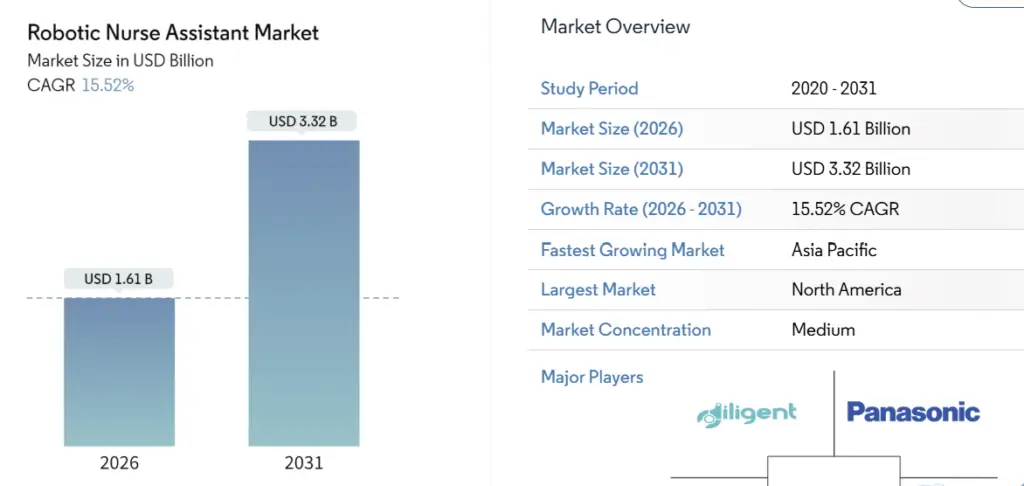
The robotic nurse assistant market is expected to grow from USD 1.39 billion in 2025 to 1.61 billion in 2026 and forecast to reach 3.32 USD billion by 2031. Demand is escalating as health systems confront a widening nurse staffing shortage. https://www.mordorintelligence.com/industry-reports/robotic-nurse-assistant-market
How AI Will Shape the Future of Health Care In 2026
New reports highlight that 2026 is the year “Ambient AI” moves from pilot to mainstream. These AI agents listen to patient-nurse interactions and draft clinical notes in real-time. This technology aims to eliminate the “administrative time sink,” which currently consumes twice as much time as direct patient care. https://sullivancotter.com/ai-and-the-future-of-health-care/
Focusing on the Misuse of AI Chatbots in Healthcare
The article cautions that AI chatbots are increasingly deployed in healthcare without regulation or validation as medical devices, posing significant risks to patient safety. It emphasizes that confidently presented yet inaccurate responses, inherent biases, and excessive dependence by both clinicians and patients can result in misdiagnosis, inappropriate treatment, and exacerbated disparities, highlighting the urgent need […]
Kontakt.io Introduces Patient Journey Analytics to Transform Hospital Operations Through Digital Twin Intelligence
Kontakt.io has introduced a next-generation data layer that creates a “digital twin” of hospital operations to track the patient journey in real-time. This eliminates operational uncertainty for charge nurses, providing a predictive view of bed availability and discharge bottlenecks hours before they occur. https://www.prnewswire.com/news-releases/kontaktio-introduces-patient-journey-analytics-to-transform-hospital-operations-through-digital-twin-intelligence-302655253.html?tc=eml_cleartime
AI & Nursing: Leading Boldly into 2026

The FloGatorAI initiative is developing AI-powered scenarios for nurse simulation training. This ensures that new nurses enter the workforce “AI-literate,” capable of spotting when an algorithm is authoritative but clinically invalid. https://nursing.ufl.edu/2026/01/20/ai-nursing-leading-boldly-into-2026/
Top AI Trends in Healthcare Driving Innovation in 2026

New forecasts show that multilingual AI chatbots for scheduling and triage are saving the industry billions. For clinic nurses, these systems handle the “administrative noise,” allowing them to focus on complex intake assessments and patient education. https://www.xsolis.com/blog/ai-trends-in-healthcare/
Arrive Point smart mailboxes free up hospital staffers for patient care
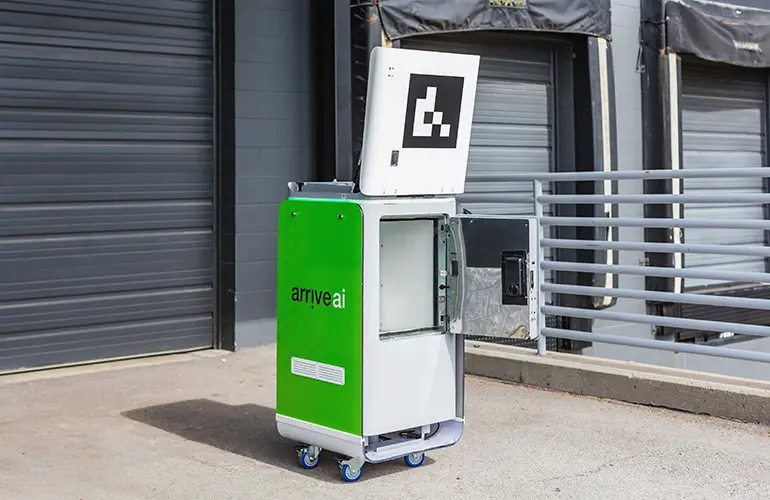
Arrive AI has launched the Arrive Point network, which uses robots and drones for secure hospital deliveries. By automating the “supply chain” within the hospital, these systems free up nursing staff who would otherwise spend hours each week tracking down equipment or medications. https://www.therobotreport.com/how-ai-powered-smart-mailboxes-free-up-hospital-staffers-patient-care/