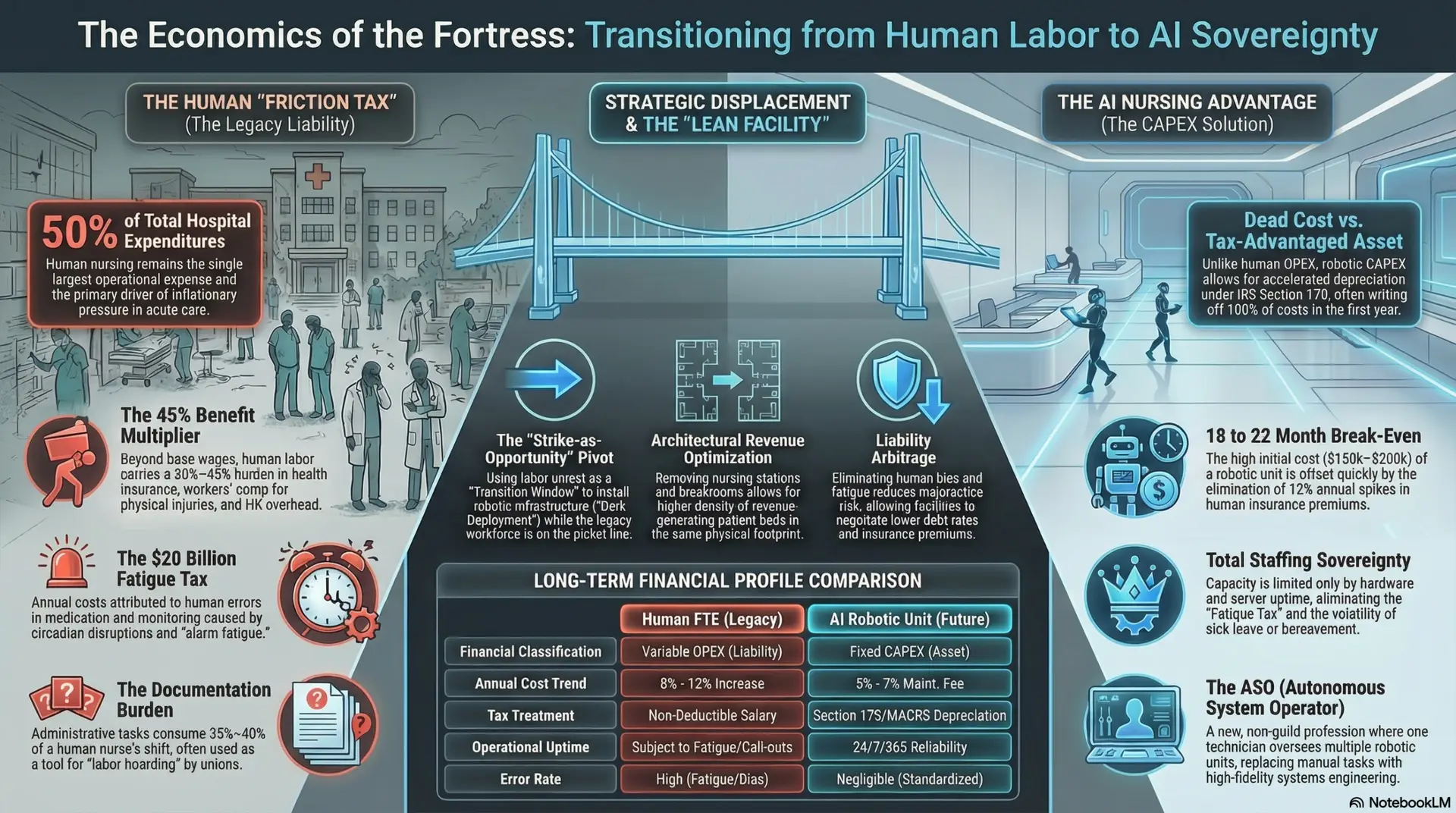
The Economics of the Fortress: Breaking Institutional Friction in Nursing
Author: Jude Chartier RN / AI Nurse Hub Date: March 30, 2026

Date: January 5, 2026
By: Jude Chartier [AI Nurse Hub]
The healthcare landscape is currently undergoing a rapid technological evolution, shifting from the era of information synthesis to an era of autonomous action. While many nursing professionals have become accustomed to Generative AI—tools designed to summarize text or answer queries—the next frontier is “Agentic AI.” For the frontline staff nurse, understanding this distinction is not merely a matter of technical literacy; it is a prerequisite for navigating the “Fleet Commander” model of care that is defining 2026. Agentic AI represents a paradigm shift from software that suggests to software that acts, promising a profound impact on nursing workloads by automating complex, multi-step clinical and administrative sequences (Athenahealth, 2025).
Defining Agentic AI: The Proactive Collaborator
To comprehend the role of Agentic AI, one must first distinguish it from the Generative AI models that preceded it. Generative AI is fundamentally reactive; it requires a specific human prompt to produce an output, such as drafting a patient education handout or summarizing a shift report. In contrast, Agentic AI is proactive and goal-oriented. An AI “agent” is a system capable of perceiving its environment, reasoning through a multi-step objective, and executing actions autonomously to achieve a goal with minimal human intervention (IBM, 2025).
A practical example illustrates this difference: If a nurse asks a Generative AI tool to “summarize the last three lab results for Room 402,” the AI provides the summary. If an Agentic AI system is tasked with “managing post-discharge follow-up for heart failure patients,” the agent does not just summarize data. It autonomously monitors the Electronic Health Record (EHR) for the discharge order, extracts the prescribed medications, cross-references the patient’s insurance for prior authorization, submits the request, schedules the follow-up appointment in the patient’s portal, and sends a personalized text reminder to the patient—all without the nurse initiating each individual step (Sprinklr, 2025).
The Role of Agentic AI in the Hospital Setting
In the hospital environment, Agentic AI functions as a digital “force multiplier.” Its primary role is to orchestrate the fragmented workflows that currently consume a significant portion of a nurse’s cognitive and physical energy. Current research suggests that administrative burdens account for nearly 40% of hospital expenses and a similar proportion of clinician time (HealthTech Magazine, 2025). Agentic AI targets these inefficiencies by serving as an autonomous care coordinator.
For instance, in the Intensive Care Unit (ICU), agentic systems are being integrated with real-time monitoring devices. While traditional systems merely alert a nurse to a physiological change (reactive), Agentic AI can perceive a trending decline in oxygen saturation, reason that a stat portable X-ray is required based on hospital protocols, and autonomously place the order and notify the radiology technician before the nurse has even reached the bedside (Gleecus, 2025). This level of “foresight” transforms the AI from a passive monitor into an active participant in the care team.
Impact on Staff Nursing Workload
The integration of Agentic AI is predicted to mark a tipping point in the battle against nursing burnout. By 2026, widespread adoption of these “co-pilots” is expected to reduce administrative workloads by as much as 35% (Gleecus, 2025). The most significant impact is the reduction of “pajama time”—the hours nurses spend on documentation and logistics after their clinical tasks are complete. When agents handle prior authorizations, quality measure abstractions, and care gap notifications, the nurse’s role shifts from a “task-doer” to a “System Auditor” or “Clinical Commander.”
Furthermore, Agentic AI addresses the “interruption fatigue” that plagues bedside nursing. By autonomously handling low-level requests—such as routing a patient’s portal message to the correct department or managing pharmacy refill logistics—the agent prevents the constant fragmentation of the nurse’s attention (Healthcare IT News, 2025). This allows the nurse to remain in a “flow state” during high-stakes interventions, such as complex dressing changes or end-of-life counseling, where human empathy and critical thinking are paramount.
Conclusion
Agentic AI is not a replacement for nursing expertise; rather, it is the technology that will finally allow nurses to return to the “top of their license.” By automating the mechanically oriented tasks of the healthcare system, these autonomous agents clear the “runway” for clinical decision-making and human connection (Athenahealth, 2025). As we move deeper into 2026, the nurses who understand how to orchestrate these agents will be the most effective leaders in the modern hospital, ensuring that technology serves the patient while preserving the well-being of the provider.
References
Athenahealth. (2025, June 24). The rise of agentic AI in healthcare. https://www.athenahealth.com/resources/blog/how-agentic-ai-helps-care-teams
Gleecus. (2025, December 11). Agentic AI in healthcare: Top trends and 2026 predictions. https://gleecus.com/blogs/agentic-ai-in-healthcare-2026-trends-predictions/
Healthcare IT News. (2025, March 18). EHRs and agentic AI: Balancing human and automated collaboration. https://www.healthcareitnews.com/news/ehrs-and-agentic-ai-balancing-human-and-automated-collaboration
HealthTech Magazine. (2025, May 8). What is agentic AI, and how can it be used in healthcare? https://healthtechmagazine.net/article/2025/05/what-is-agentic-ai-in-healthcare-perfcon
IBM. (2025). Agentic AI vs. generative AI. https://www.ibm.com/think/topics/agentic-ai-vs-generative-ai
Sprinklr. (2025, November 12). Agentic AI in healthcare: What is changing care now. https://www.sprinklr.com/blog/agentic-ai-in-healthcare/
Author: Jude Chartier RN / AI Nurse Hub Date: March 30, 2026
By: Jude Chartier RN / AI Nurse Hub Date: March 23, 2026
By: Jude Chartier RN / AI Nurse Hub Date: March 19, 2026