By: Jude Chartier / [AI Nurse Hub]
Date: January 2026
Introduction: The Evolution of the Nursing Interface
For decades, the nursing relationship with technology was defined by the Electronic Health Record (EHR)—a digital filing cabinet that often felt like it added more work than it saved. However, as we move into 2026, a fundamental shift is occurring. We are transitioning from “data entry” to “data orchestration.”
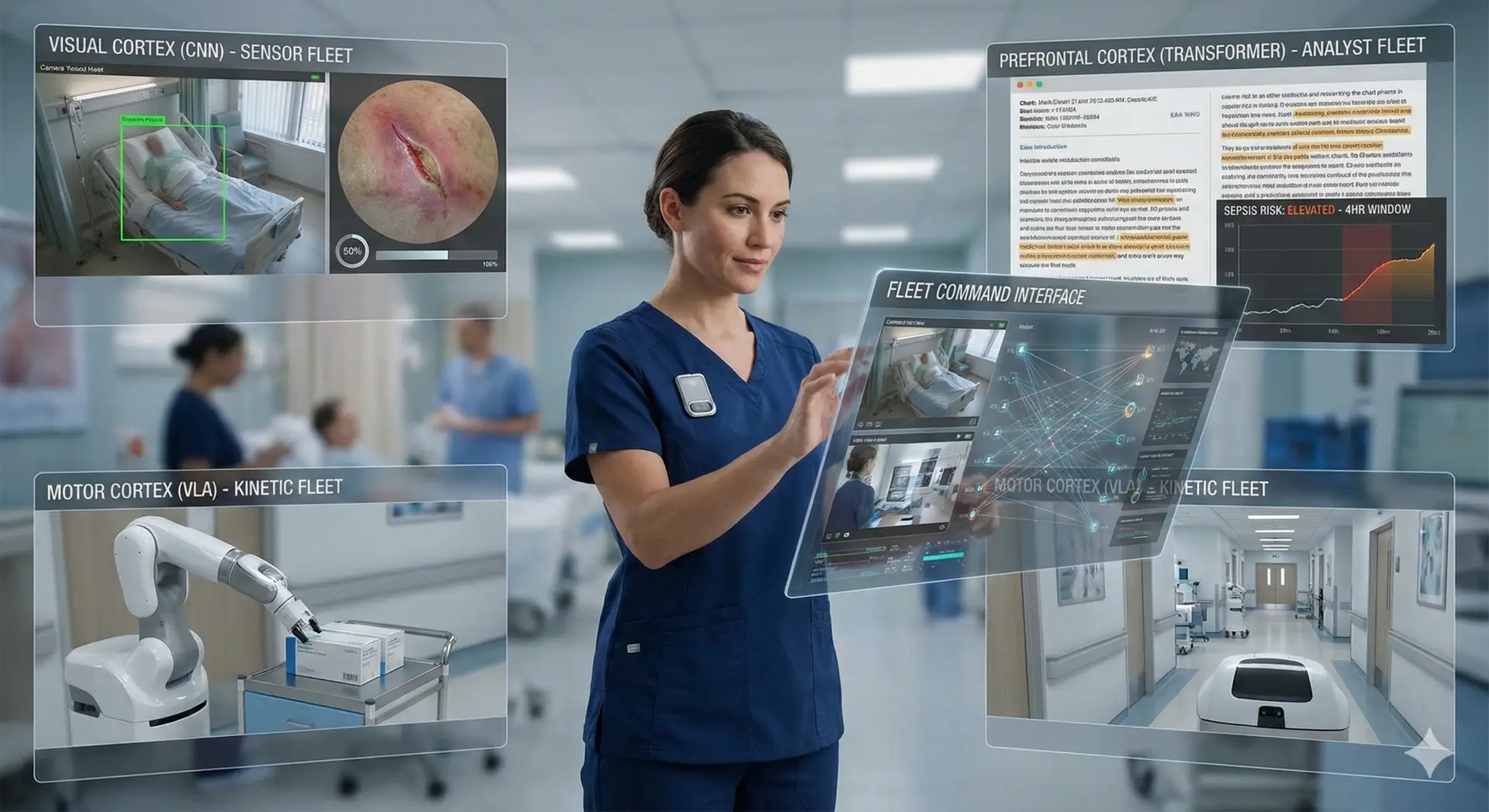
Current trends in healthcare suggest that AI is no longer just a chatbot; it has become a series of specialized “brains” designed to support clinical judgment (Wolters Kluwer, 2025). To navigate this, nurses must understand the underlying structures of these systems. This understanding is the first step toward the “Fleet Commander” concept—a role where the nurse oversees a coordinated “fleet” of AI agents and robotic assistants to deliver superior patient care.
1. The Convolutional Neural Network (CNN): The “Eyes” of the Unit
In the human brain, the visual cortex processes what we see. In the AI world, this is the job of the Convolutional Neural Network (CNN). These models are designed to recognize patterns in images and videos by breaking them down into pixels and identifying edges, shapes, and textures.
- Clinical Relevance: CNNs are the backbone of automated wound assessment and fall prevention.
- Real-Life Example: Research has shown that CNN-based algorithms can detect early-stage pressure injuries and skin tumors with accuracy levels rivaling experienced dermatologists (Marr, 2025). On your unit, a CNN-powered camera might alert you that a patient in Room 4 is exhibiting “pre-fall” movement patterns—subtle shifts in weight and posture that a human eye might miss while multitasking.
2. Transformers: The “Linguist and Historian”
The “T” in GPT stands for Transformer. This architecture is revolutionary because it uses a mechanism called “attention” to understand the context and relationships between data points over time (PubMed, 2024). It doesn’t just read words; it understands the story they tell.
- Clinical Relevance: This is the brain behind Ambient Clinical Intelligence (ACI).
- Real-Life Example: Systems like Nuance DAX or Abridge are currently being implemented to “listen” to nurse-patient interactions. The Transformer model filters out irrelevant conversation and automatically drafts a structured nursing note in the EHR, potentially saving nurses up to 40% of their shift time previously spent on documentation (Holy Family University, 2025). It also acts as a historian, scanning years of patient data to flag subtle trends—like a creeping creatinine level—that suggest a high risk for acute kidney injury.
3. Vision-Language-Action (VLA) Models: The “Hands and Feet”
The newest arrival in 2026 is the Vision-Language-Action (VLA) model. This is the first “native” robot intelligence. Unlike older robots that followed rigid, pre-programmed paths, VLA models unify perception (Vision), understanding (Language), and movement (Action) into one brain (arXiv, 2025).
- Clinical Relevance: These models power the Embodied AI or “care-bots” that assist with physical tasks.
- Future Use: A VLA-powered robot doesn’t just “carry things.” Because it understands language, you can tell it, “Fetch the bariatric walker from the supply room,” and it can identify the specific item, navigate a crowded hallway, and deliver it to the correct bedside (RoboCloud Hub, 2025).
The Future: You as the “Fleet Commander”
As these technologies converge, the nursing role is shifting toward the Fleet Commander model. In this framework, the nurse is the central authority—the “Commander”—who manages a fleet of digital and physical assistants:
- The Sensor Fleet (CNNs): Monitoring vitals and skin integrity 24/7.
- The Analyst Fleet (Transformers): Managing documentation and predicting clinical risks like sepsis.
- The Kinetic Fleet (VLAs): Handling logistics, heavy lifting, and supply management.
The Army Medical Department and other leadership organizations have already begun exploring this “Command and Control” approach, where AI processes the “noise” so that human leaders can make the decisive “action” (Army University Press, 2024).
Conclusion: Why Nurses Stay at the Center
Despite these advanced “brains,” AI lacks two things critical to nursing: Ethical Agency and Empathy. A model can predict a fall, but it cannot comfort a frightened patient. It can fetch a bandage, but it cannot decide the ethical course of care for a terminal patient. By becoming “Fleet Commanders,” nurses are not being replaced; they are being promoted. We are being freed from the “grunt work” of data entry and heavy lifting to return to what we do best: the art and science of human healing.
References
- American Association of Colleges of Nursing (AACN). (2025). Exploring the future of nursing education: AI at the 2025 Thought Leaders Assembly. https://www.aacnnursing.org/
- Army University Press. (2024). Army medicine and artificial intelligence: Transforming the future battlefield. Military Review. https://www.armyupress.army.mil/